Showing posts with label illustration. Show all posts

Friday, 24 May 2019

Further Adventures in Illustration

By Nick Cross

Vintage book cover from the Baldwin Library of Historical Children’s Literature

It’s been a whole year since I last shared my experiences as a budding illustrator, so I thought it was high time to inflict more of my art on you give you an update.

The submission process for my illustrated YA novel has been taking its toll (see my previous post for more about that), and my writing has been on hiatus recently. To the extent that I’ve started to dread that question you get asked at writing events: “So, what are you working on?” Anyway, to compensate, I’ve been devoting more time to my art and illustration work.

Since I started illustrating two years ago, I’ve found my slow progress frustrating. A reasonable person might say it takes time, effort and patience to learn a new skill, but clearly I am not that person. As a type A perfectionist who is starting to feel the sands of time running out, I want instant results and I want them now! This intolerance for imperfection is, frankly, not helpful when trying to learn a complex new skill.

Do I enjoy drawing? Sometimes, although I still find it very difficult. I remember a long period of writing where I couldn’t make the words on the page come out how I wanted them to, and drawing has been the same. Except with drawing, I felt extra pressure because someone else could look at the source photo and see just how far my representation had fallen short.

Because I wasn’t enjoying drawing, I also wasn’t doing the one thing that everyone recommends, which is to draw every day. I would draw half-heartedly occasionally but never with a consistent goal. It occurred to me that working in Oxford, I had all these fabulous museums on my doorstep, including the Ashmolean, Natural History and Pitt Rivers. I resolved to take my pen and sketchbook, and spend a couple of lunchtimes every week drawing stuff.

There were pros and cons to this approach. On the plus side, there are lots of things to draw - you can pretty much wander into the Ashmolean and find something totally new every time. On the minus side, there are a lot of visitors and tours - I would regularly look up from my sketchbook to find a group of people blocking my view! But I did learn some important things about my method. Take these drawings of the same statue as an example:


The sketch on the left was something I did very rapidly, just as a warm up. I found that once I had got some of the perfectionist anxiety out of my system, I could concentrate on really “seeing” the subject. The sketch on the right (though the proportions are a bit iffy) reflects that enhanced concentration.

Although I went museum sketching for a couple of months, the very public nature of the process started to grate on me. I’m intensely protective of my creative process, and didn’t like the fact that people could watch me as I worked. Rather than use it as an excuse to show off, I became intensely paranoid and my work started to suffer. It was time to pivot again - I started booking empty conference rooms at work during the quiet lunchtime period, and working in seclusion.

This worked a lot better for me, removing prying eyes and the pressure of working quickly. I decided to stay with similar subject matter, selecting photos of Greek and Roman statues to draw from. Here are a couple of my sketches:


I was much happier with these, though at the end of the hour, the desk was always covered with grey crumbs from rubbing out. However, I read a recent interview with the late, great, Judith Kerr where she said (after a very long career as an illustrator) that she still rubbed out more than she actually drew. So maybe I’m not such a weirdo after all.

I started to realise that I wasn’t interested in landscapes or architecture like I'd thought - I wanted to draw people! My wife and I were watching the Sky TV show Portrait Artist of the Year, and I was encouraged by the contestants who used gridding to transfer the dimensions of a subject’s face onto the canvas. I decided to attempt a portrait (something I had previously thought way beyond my skill level) with a grid built using a helpful online tool. The photo itself was something I found on Unsplash, which is a copyright free image site:


I found using the grid to be a revelation! By reducing the size of the problem, it allowed me to concentrate on just what was happening inside each square. Any preconceptions I had about the shape of a person’s face could be safely ignored - I just had to draw what was in front of me. Once the pencil sketch was done, I wanted to shade it using fineliners, but it was clear from my tests that it would take a long time. So I opted for Winsor and Newton ProMarkers, which I had used for my earlier illustration work. Here’s the result:


It’s good, right? I was a bit amazed when I finished it to be honest! It was the first time that the lines on the page actually seemed to match the photo.

For my next drawing, I resolved to do a bit of fan art, based on the noughties TV show Veronica Mars, which we were rewatching. Kristen Bell is totally awesome in that show, and it was fun to try to capture her likeness. With the gridded pencil sketch done, I made a photocopy to try out different ProMarker colour choices:


I’d recently bought some Bristol Board to try out, so I used it for the finished picture. As well as being fairly expensive, It’s also quite shiny, but the alcohol-based ProMarkers work on practically any surface. The best thing about Bristol Board is how easy it is to rub stuff out! Despite the cost, I may have found my perfect medium.


I was less satisfied with this final artwork than my earlier portrait of the butterfly guy. Although the likeness is recognisable, something about the face just isn’t quite right, though I couldn’t tell you exactly what! It’s definitely much harder to draw someone whose face you’re very familiar with. I also had a lot of trouble with the blonde hair - in retrospect the black hair of the previous subject was very straightforward.

I did start a third portrait, but had to put it to one side because I wanted to tackle the optional task for a recent SCBWI illustration masterclass called The Wonderful World of Non-fiction Illustration. I’m also writing a review of the session for Words & Pictures, so I’m working on both posts simultaneously to avoid repeating myself!

The task was to make an A3 double page spread showing a creature in its natural habitat. That meant museum time again - I went to the Oxford Natural History Museum and took photos of various specimens.


I decided to pick the Japanese spider crab, because I liked the bright colours and the way it would fill an A3 page. The brief made it clear that the research was as important as the finished work, so I made various sketches and an A4 dummy.

To mimic a lift-the-flap book, I made the artwork in two layers. The top layer was drawn on tracing paper:


So you could lift it away to see this underneath:


In order to get everything to line up, I scanned my pencil sketch, added the text in Photoshop and printed just the text on the tracing paper. Then I added the crab’s body and missing leg on the top sheet in ProMarker. This allowed me to keep the bottom layer drawing as just the pure artwork. Working on top of tracing paper was still quite difficult though - if I’d had more time, I think it would have been better to draw the body and leg on a separate sheet, scan them in and composite the top layer digitally.

The bottom layer was drawn on lightweight marker paper rather than Bristol Board, as I needed to roll up the drawing to take it to London.

Later, as I inspected the other illustrations at the workshop, I had to wonder why I'd picked something so terrifying to work on rather than a nice fluffy mammal. There were a number of occasions while researching spider crabs that I had to stop Googling them because the photos were putting me off my lunch! And yet, my chosen style and medium wouldn’t have worked half so well on something with fur or feathers.

I pushed myself really hard with the task for the masterclass, even working on it the morning of the session (by which point I was terrified I would screw it up). I knew that I wouldn’t be able to avoid comparing myself with the other illustrators, so I wanted to make a good show of it. Which I feel I did in the end, and I got some useful feedback from the tutors. I was pretty exhausted that evening, as you can imagine!

I feel that I’m slowly becoming better at illustration and that’s a positive thing. Honestly, all I’ve ever aspired to be is competent! I’ll keep you posted on where the muse takes me next...

Nick.


Nick Cross is a children's writer/illustrator and Undiscovered Voices winner. He received a SCBWI Magazine Merit Award, for his short story The Last Typewriter.
Nick is also the Blog Network Editor for SCBWI Words & Pictures magazine. His Blog Break column appears fortnightly on W&P.

Friday, 23 March 2018

Adventures in Illustration

By Nick Cross

Vintage book cover from the Baldwin Library of Historical Children’s Literature

Over the past few months, I’ve been taking my first steps to become an actual, genuine illustrator. This has primarily consisted of taking a weekly evening class in Oxford, studying Beginners' Illustration for Children’s Picture Books. The course is taught by Korky Paul, who many of you will know from his work on the hugely-successful Winnie and Wilbur series. Korky, a thirty-year veteran of the picture book industry, has run the ten-week course for over fifteen years. It’s also very affordable, thanks to being part of the Oxfordshire Adult Learning programme.


After my first term of studying art last year, I felt very apprehensive about jumping straight into something that sounded a lot more advanced. But my work colleague (and fellow SCBWI member) Imogen Foxell had been on the course two years ago, and she encouraged/bullied me until I signed up.

One of the prerequisites of the course was a portfolio containing at least five pieces of illustration work. This was a problem for me, because I don’t really have any prior work to speak of. So, a month before the course started, I decided to find a picture book story I could illustrate.

I’m not really a picture book writer, but I was very lucky that my friend Nick Bromley (Waterstones Children's Book Prize-winning writer of Open Very Carefully) is! Nick (not me, the other one) was willing to let me rummage around in his unpublished stuff until I found a text called A Sticky Situation. This anarchic, metafictional tale of subversive sticky notes really spoke to me, and I could see lots of creative potential for the illustrations.

With the text in hand, I started work on a couple of spread ideas for the book, which I supplemented with three spreads from the illustrated YA novel I’m also working on. Although I was immensely nervous the first week (and pretty much every week) of the course, I bravely took out my five A3 sheets and showed Korky what I’d drawn. In actual fact, it turned out that I knew quite a lot about the design and layout of picture books, even if I didn’t know much about the illustration side. Conversely, many of the other participants had a lot more artistic experience than me, but needed help to organise and present their ideas.

The objective of the course is that we should come out after ten weeks with three fully finished spreads and several roughs, suitable for submission to a picture book art director. I had already chosen my text to illustrate, but Korky also supplied a wide selection of alternatives, some in the public domain and others donated by writers specifically for the course participants.

Each week of the course follows a similar structure. First, we are all encouraged to bring in interesting picture books, which are then displayed to the class and discussed. Here are some of my choices:


As you can see, quite an eclectic selection - I wanted to be varied and explore some titles that weren’t typical picture books.

After the book discussion, we move on to an appreciation of the latest illustration work that the students have produced. Korky looks at our sketches, roughs and finished artwork, commenting on composition, layout and technique. The students are working on a wide range of subjects in several different media, and it’s fascinating to see how their work is progressing. Korky tries to treat the whole exercise like an editorial meeting, giving considered and professional feedback. He does like to draw all over the artwork as he is illustrating a point, but I’m quite protective and don’t like this, even on my roughs! But once I told Korky this, he was happy to draw on a separate sheet of paper instead.

After the editorial feedback, the final part of the class focuses on one of Korky’s own picture books. He has a whole room in his house for his archives, and each week brings in a giant folder containing all of his sketches, roughs and finished artwork for a particular project. It’s very instructive to see how ideas evolve, and Korky is always keen to point out areas that changed due to editorial feedback. Sometimes, an idea that he doodled in an initial meeting becomes the finished article, other times many drafts are needed to make the art director happy. The finished artwork is particularly exquisite - Korky has such finely-detailed penmanship and an incredible watercolour technique that I’m always a bit worried about ruining his paintings. Korky is also amazing at hand lettering - a necessary skill when he worked in advertising in the 1970s.

So far, we’ve looked at the archives for books such as Winnie and Wilbur Meet Santa and Sir Scallywag and the Golden Underpants, pantomime poster artwork for the New Theatre in Oxford, and even a couple of secret projects that I can’t talk about because they haven’t been published yet!

I always ask a lot of questions when I’m taking a course, and this one has been no exception. At times, I’ve wondered if that’s annoying for everyone else, but no-one’s told me to shut up (yet). Korky is always very patient with our queries and happy to explain all aspects of the publishing process.

There isn’t time in class for doing any actual illustration (though Korky did give us a watercolour masterclass one week). So that entails quite a lot of homework to make progress. I’ve settled into a rhythm of writing my YA novel during the week and doing illustration at the weekends. This seems to work well, especially as the larger artwork and materials aren’t particularly portable. I’m also very shy about my illustrations, so doing them in the privacy of my kitchen helps.

My chosen medium for picture book illustration is Windsor and Newton Promarkers. These are alcohol-based markers, which come in a wide range of colours:


They’re also readily available at art shops and even some branches of WH Smith, which makes life easier when one runs out at a vital moment. Promarkers are very similar to Sharpies or the Copic Ciao brand of markers - I love the vibrant highly-saturated colours you get from them. If you read my earlier post, you’ll remember how much I disliked mixing paint colours, so having something in a pre-mixed shade is perfect.

As with any new art technique, there’s been a significant learning curve. Windsor and Newton make special marker paper, with a coating that stops the ink bleeding through. However, as I discovered to my cost, this only works if you use the correct side of the paper! I ruined two carefully-inked pictures because of this, which was a “learning experience” for sure (interesting how "learning experiences" are often accompanied by a lot of swearing!)

I’ve also had problems with bleed from my ink work. To start off, I inked my pencil lines with a black Promarker, then used coloured Promarkers over the top. But although Promarkers are permanent on most surfaces, it turns out that the alcohol in the coloured markers reactivates the black, causing it to run into the lighter colours. I then tried a “waterproof” Faber-Castell Pitt pen, with the same result - waterproof doesn't necessarily mean alcohol-proof kids! Finally, after some research, I discovered that Copic make a special range of alcohol-resistant Multiliner pens, which should save me a lot of Photoshopping.

I’ve learnt a lot about my own creative process during the course. For instance, I’ve discovered that the way I draw is very similar to the way I write - I like to work iteratively. Starting in pencil, I ink the design directly on a lightbox, add colour and finally scan the page for fine-tuning in Photoshop. After Korky has given his feedback, I don’t generally want to redraw the whole thing, so I will return to the pencil work and correct it before inking and colouring again. Working digitally for the final pass makes it much easier to tweak and swap out elements, without going back to square one each time.

I’d never done any figure drawing or character design before I started the course, so it’s been a steep learning curve! I knew I wanted to do something quite cartoony - here I am trying out some designs for my main character, Charlie:


Because of my aphantasia (I lack a visual imagination or “mind’s eye”), I already knew that I was going to have to work from photos wherever possible. Google Image Search turned out to be a lifesaver here - I could literally type in a phrase like “woman wearing sunglasses in profile” and get lots of images to work from. Here are some snapshots from the evolution of one of my drawings, which shows Charlie’s mum having fun at the beach:


  1. My initial sketch. I did this completely out of my head, and you can see the results - poor body position, hands and legs.
  2. Redrew the body, legs and feet, and tidied up the hands. The bikini bottoms are much better here - she looked like she was wearing a nappy before!
  3. Inked the previous pencil drawing and coloured with Promarkers. The results are OK, although I didn’t really get on with the brush pen I was using - some of the lines, especially around the hands, are very thick. Someone on the course also pointed out that Mum wasn’t wearing sunglasses, which is the whole point of the drawing!


  1. Completely redrew Mum’s head by looking at a reference photo rather than trying to make it up. Sunglasses now present and correct.
  2. Re-inked the pencil drawing using Copic SP Multiliner pens. I used a brush pen for most of the lines and a 0.5 fineliner for some of the detail on the hands and face.
  3. The finished artwork, coloured with Promarkers

One thing I’ve struggled with is my pen control, or lack of it. I’ve found brush pens particularly frustrating - I never know how thick or thin a line is going to be until after I’ve drawn it. Fineliners are much more pleasurable and reliable to use, but they lack some of the organic flair of a brush.

Here’s the first finished spread of A Sticky Situation in all its glory:

Click to enlarge

At this scale, it probably isn’t obvious how many weeks of effort I’ve put into this! Hopefully, the following spreads will be a bit easier - in retrospect, having four separate pictures on the first spread of the book was rather ambitious.

The background gradients for sky and sea were produced by blending several Promarkers, which is quite challenging. I composited the backgrounds into the picture digitally, while still preserving a nice organic effect. Several people have mentioned to me that I could be doing all the colouring in Photoshop, but I’m really keen to learn the manual skills first. Also, a lot of digitally-coloured picture books look very glossy and artificial, an effect I’m keen to avoid.

Me and Korky Paul

Generally, I’ve been happy with my progress on the course, even if I won’t have the three finished spreads that were our objective. Whenever I’m getting impatient at my lack of skill, I have to remind myself that I’ve only been drawing for seven months!

After the course finishes, I’m going to take a short break from illustration to work on my observational drawing. I’ve bought a couple of great books on pen & ink drawing and perspective, but haven’t had much chance to try them out. I think some life drawing classes would also help with my figure work. So much still to learn, and a whole YA book to illustrate in the second half of the year. Wish me luck!

Nick.

P.S. If you're interested in joining Korky Paul's Oxford course, it runs from January to March each year. The 2019 course dates aren't up yet, but they'll be published here later in the year.


Nick Cross is a children's writer/illustrator and Undiscovered Voices winner. He received a SCBWI Magazine Merit Award, for his short story The Last Typewriter.
Nick is also the Blog Network Editor for SCBWI Words & Pictures magazine. His Blog Break column appears fortnightly on W&P.

Friday, 26 January 2018

Drawing While Terrified

By Nick Cross

Click any photo to enlarge it

In last year’s blog post Coming Out, I revealed the fact that I wanted to upgrade myself from writer to writer/illustrator. Amazingly (to me anyway), it’s been six months since I posted that, so I thought I’d give you an update on my progress.

The title of this post describes my state of mind through much of the last half year when it came time to pick up a pencil or paintbrush. But I’m pleased to report that the terror has mostly subsided. When I sat down last weekend to create the hand-drawn parts of the image that headlines this post, I even managed to enjoy the process.

This enjoyment is either despite or because of the trial-by-fire that was the Beginners’ Drawing and Painting evening course I joined in September last year, which sped through various disciplines so fast that I almost got whiplash.

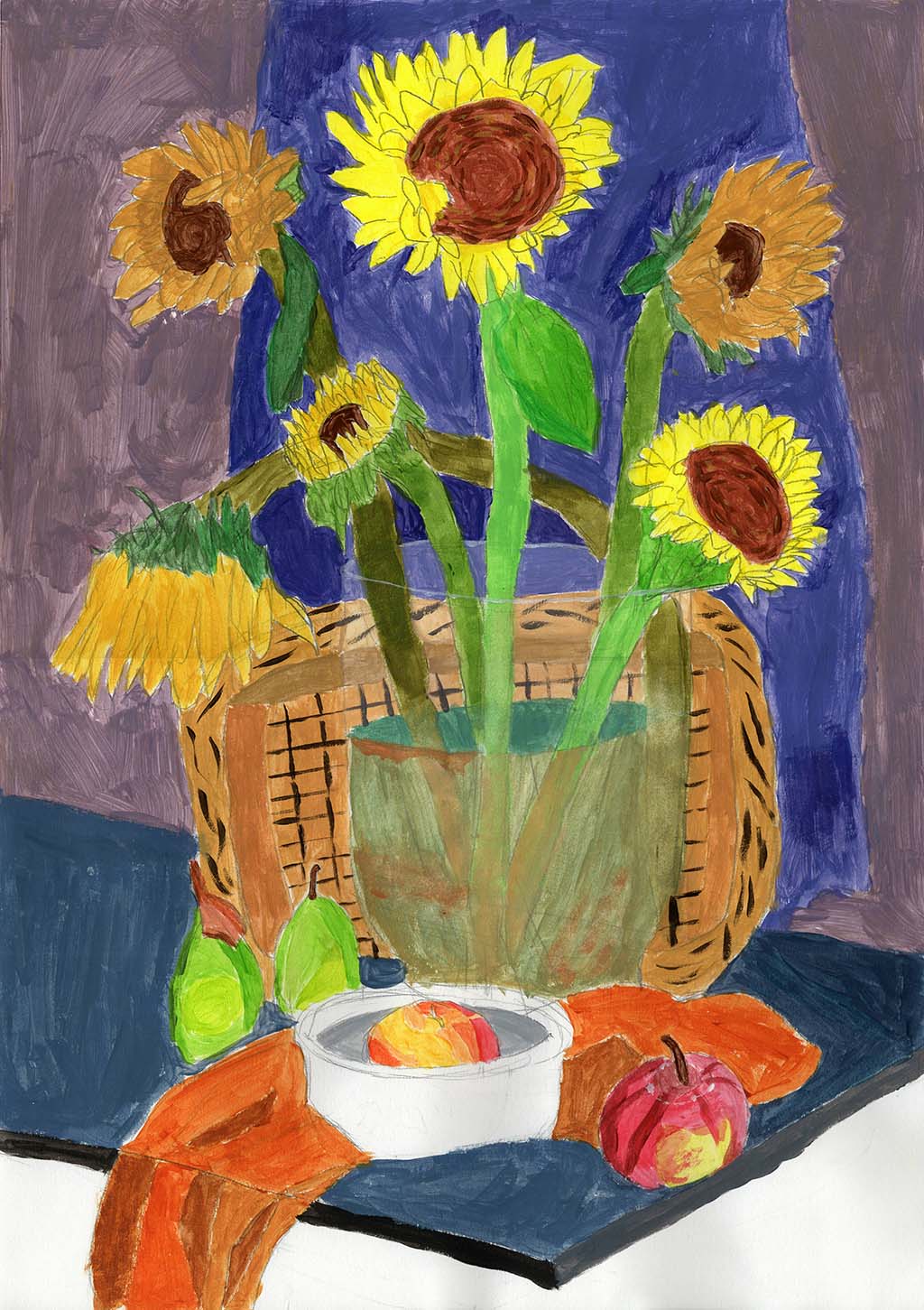
We began with gouache painting, which wasn’t an ideal starting point for a complete novice like me. In fact, everyone who I’ve mentioned this to has said “Why didn’t you start with basic drawing skills?” And truthfully, I have no idea - that was just the way the art teacher liked to do it.

To be fair, we did begin with a drawing, a big sketchy sketch on A2 paper to get the composition right. Knowing my control freak ways, I tried to be all loose and expressive with this and it actually didn’t look too bad. Then we started painting over the top, which is where I started to come unstuck. I’d never realised how HARD it is to mix paint. It feels like constantly chasing an impossible goal, adding first one colour, then another, then yet another. And then, once you’ve finally attained a rough approximation of the colour you want, it runs out halfway through the painting and you can’t remember how to mix it again!

The teacher had advised us that we could buy an expensive set of gouache paints costing £25, or go for something cheaper. I bought a Daler-Rowney set for a tenner, and sadly, it was rubbish. The paints came out of the tube all blobby (making them even harder to mix) and the coverage of my paint on the paper was a lot poorer than the other students. This was my first lesson in the quality of art materials - although two tubes of paint may look exactly the same, there’s a genuine reason why one costs twice as much as the other.

I also got tripped up by the quality of my initial sketch. Although it was impressively loose, there wasn’t enough detail in places to do justice to the subject. This is another big lesson for me - I’m not great at freestyling yet, so my finished picture is only ever going to be as good as my underlying pencil drawing.

OK, enough caveats - here is my finished gouache painting:


That strange brown thing behind the vase is a basket, BTW...

Next up was a tonal pencil drawing, and the one part of the course I really enjoyed. I had looked for an art course that was for drawing only, but had struggled to find one in my local area that wasn’t at 2pm on a weekday afternoon (for retired people, I assume). Although I found pencil drawing a real technical challenge, at least there was no colour mixing involved! Cross-hatching and shading were two concepts I was very aware of, and very aware that I didn’t know how to do them. There was a magical moment in the second week when everything just clicked and I could suddenly see (and reproduce) tonal range.

The drawing was another A2 composition, which meant a lot of paper to cover and a lot of graphite to accidentally drag the heel of your hand through. I’m very detail-oriented, so working at A3 is probably a better size for me. The teacher insisted on putting another blimmin basket in the still life, though I managed to render it rather better than last time. Overall, I’m very pleased with the finished result:


This used a range of pencil grades from HB to 4B. Another lesson I learnt (albeit one I should remember from primary school) was that pencils can be difficult to make really sharp without breaking the lead. If you’re not careful, you can quickly end up with just a stub! To avoid this problem, I’ve started using a mechanical pencil with 2B leads for most of my sketching.

The final task of the term was executed in an unusual hybrid of white gouache plus pen and ink. When asked what the style was called, the teacher replied “Oh, I don’t know. I just made it up.” This was typical of her somewhat “artistic” approach to the class. Rather than show us how to do a particular technique, she liked to throw us in at the deep end and see what we produced. As a total novice, I would have preferred more structured guidance, and found that I was constantly behind everyone else, struggling to catch up. I also found the two and a half hour session much too long to maintain such an intense level of concentration. When I’m working at home, the length of an album (around 45 minutes) is about the right amount of time to spend before I take a break.

We were using a dip pen and various coloured inks, which caused technical problems because of the variable quality of the nibs and the viscosity of some inks. Although it’s an expressive medium that allows variation in line width, working in pen and ink did make me yearn for some nice black fineliners. The subject was yet another still life - by this point, I was a bit bloody fed up of these!

The finished result remains, um, unfinished, because we ran out of time. And I’ve not yet felt motivated to buy inks and a dip pen to finish it:


Overall, my experience on the first term of the course was mixed. Although I made a lot of progress, it was not a pleasurable experience - I felt anxious and out of my depth most of the time. Just the fact that I didn’t bolt from the room screaming was an achievement. I learnt that I need space and time to do my best work, drawing little and often rather than trying to get everything done in a hurry.

This A3 drawing of a Star Wars X-wing is something that wouldn’t have been out of place on twelve-year-old me’s bedroom wall, if I’d been able to actually draw at that age. It’s also the first independent project I completed after the course ended. I think it's safe to say that I'm no longer a stranger to cross hatching!


No dip pens here, just an excuse to use the pack of various width fineliners that called to me from the shelf at WH Smith. Indeed, I’ve had the opportunity to amass a lot of art materials over the past half year. My previous marker pen obsession has grown to epic proportions, as this photo demonstrates:


As a writer, I have never been into exciting stationery, preferring a plain A6 notebook and a Bic biro. Clearly, the illustrator side of my personality is very different!

Finally, a quick progress check. At last year’s SCBWI Picture Book Retreat, we were given a postcard and asked to list our three goals for the forthcoming year. Here are mine:


1) Getting there. Thanks to this goal, I’ve set a target of the end of June to complete the manuscript.

2) Big tick. Some weeks recently, I have been drawing every day!

3) Eurgh - wish I hadn’t set this one. I look on Instagram and I think - “Why am I bothering when everyone is so much better than me?” and “Do they really have to use that many hashtags?” Expect me to join Instagram very quietly the day before this year’s Picture Book retreat.

So what’s next? Well, despite my nerves, I went to the SCBWI illustrators’ meet-up in London this week and had a good time (thanks to Louise Gilbert for organising that). As you’ve probably gathered, I haven’t returned for the second term of the evening class. Instead, I’ve signed up for an even bigger challenge: a course in picture book illustration with superstar illustrator Korky Paul! But more on that in a future post...

Nick.


Nick Cross is a children's writer/illustrator and Undiscovered Voices winner. He received a SCBWI Magazine Merit Award, for his short story The Last Typewriter.
Nick is also the Blog Network Editor for SCBWI Words & Pictures magazine. His Blog Break column appears fortnightly on W&P.

Friday, 21 July 2017

Coming Out

By Nick Cross

Photo by Ruffroot Creative

How long did it take you to pluck up the courage to tell someone you wanted to be a writer? I can remember it was a long while before I would admit to it in public, and there are still times when I’m not sure (usually when the writing is going badly). But recently, I’ve been troubled by an even bigger secret, something I’ve been dimly aware of for some years but also terrified of admitting:

I want to be a writer/illustrator.

When I revealed this information at the recent SCBWI Picture Book Retreat, I was surprised to find that nobody laughed at me. In fact, everyone was broadly supportive of my new creative orientation. So perhaps it’s only me who worries this is a terrible idea.

Share buttons bottom

POPULAR!