Friday, 29 January 2010

Thoughts on Surviving This Digital Revolution

On the launch of the iPad, some thoughts on how tools are driving content and an interview with Melvin Burgess about his Twitter Tales


If you can't see this video, watch it on YouTube.Thanks Jeannette Towey for posting this on FB

"Over 10 years we have lived through a revolution." Ed King head of the British Library's newspaper archive
When Ed King said this, he was referring to the digitisation of his archives. But it's so true in everything that we do - from reading a book to booking a plane ticket. Our lives have been transformed by technology.


With the launch of the iPad, the blogosphere is buzzing with people who want to declare how much they love it or hate it.

The iPad is yet another step into a Tomorrow that we are only just beginning to imagine.

It fascinates me that a gadget like the iPad is predicted to transform the world of story and reading.

Through the ages, tools have dictated the development of content: the printing press led to books, the zoopraxiscope led to movies, the camera to photography, and so on.
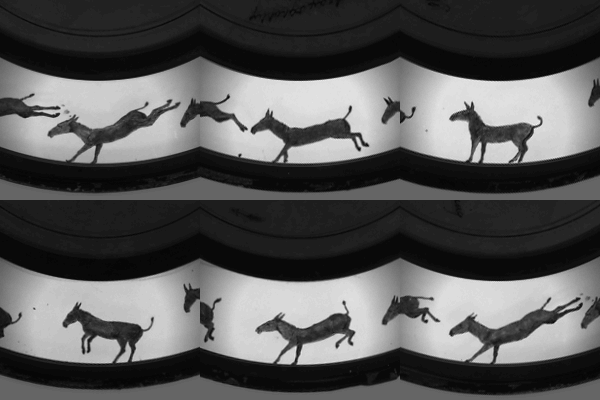

From Wikipedia under Creative Commons License

But it's important to remember that the tool is nothing without the content it provides. And as authors, who are the creators of content, it is our role to shape the future that these tools are set to deliver.

Some are already experimenting with the new media available - the Japanese download text novels on their mobile phones, today I heard about augmented reality picture books, and authors like Kathleen Duey are experimenting with twitter novels and short stories (an aside: this is not new media, but has anyone listened to the BBC's Out Loud archive of poets performing their own work? Brilliant!) ...

Deep Love, the first ever cell phone novel

I've been following the Twitter short stories that author Melvin Burgess (my review of his book Nicholas Dane here) has been posting.

Melvin Burgess. Photo by John Coombes

They are odd, poetic and strangely affecting. Melvin says they are "not to everyone's taste" but there's something compelling about them.
I was just mucking around – trying out Twitter and wondering what tweets were. Of course, all a tweet is, is a not-too-long sentence – but I was thinking of them of having some particular quality to them. Then one day I came up with the sentence – You're pushing a pram down the road. An old lady looks inside and says fearfully, "Your babies are not human."

It reminded me of something I used to do years ago, while I was learning how to write – I’d sit down in the morning and just launch off with a sentence – anything, like they used to make us do in school – and just see how it went. So I thought I’d try the same thing here. That was the first twitter story, The Dancer. I’ve kept it up because the results are surprising and interesting – and because after writing novels for so many years, it’s a real reliefe to do something that can just take me wherever it wants to go. It’s fun.
I think the Twitter Tales are exciting (and surprising is a really good word for it)... but since I don't like to stay connected to Twitter all the time, I have to go back to his website to catch up. Says Melvin:
Twitter is bad place to post stories because they go up backwards and people find it difficult to keep up with them. I think a lot of people, like you, went to the website to catch up, so lately I’ve been trying posting links on my website. It makes them easier to read, but I don’t think it gets so many people’s attention.
Indeed it's very tempting to explore these new forms. When I first heard about Japanese text novels I was sorely tempted to try and write one. It's funny how the limitations of a form seems to promise endless possibility! It would be, as Melvin says, Good Fun (if, that is, you like to write).
Various people do story telling on twitter – many try to make a story out of a single tweet, which is another thing altogether. I’m not aware of anyone doing exactly the same thing though. And yes, it certainly is satisfying – I love it. I’d really recommend it to anyone who likes to write – it’s a really liberating way to work. So far, most of them have turned out kind of OK, but I’d be quite happy to ditch one if it turned out duff. No pressure – good fun. And the fact that you do it one sentence at a time makes it easy to write, somehow.
There is a poetic quality to the stories ... like a novel in Haiku form. Says Melvin:
I do like the final product, although I think they still need a bit more work. One day I’ll go through the best of them and polish them up, As for story I  like this as a form – well, maybe it’ll turn out to be something, I’m not sure. It is, as you say, poetic – a kind of free form narrative poetry, in a way. Whether or not it’ll catch on is another matter, but one, day, I’m sure I’ll use them for something. Maybe I’ll get them set up as Apps for iPhone or something like that …
Funny, that. I've been researching how to produce freebies for punters to download on my site ... all those picture books I've written that nobody seems to want to publish - I want to produce little e-books to give away to be read on mobile phones and Gameboys. But it's a bit beyond my technical ability (for now).

I asked Melvin what his Twitter short stories are telling us about technology and its impact on culture.
It isn’t just Twitter – everyone is running around trying to find out how they can use new media to tell stories. It’s an exciting area because no one knows how it will turn out. I did a TV and online project for BBC Switch a while ago called The Well, that had a big online element – a game in which new areas of drama were hidden. That was interesting too. The programme maker, Conker Media, is very much at the forefront of using new media for broadcast and online and I hope to do more with them. It’s something every writer should keep an eye on.
Still from The Well

Screenshot from The Well game

It's a brave new world out there for authors. What's next?
Who knows? I hav a couple of online projects I’m having meetings to develop next month. There’s possibility as well that we might try to film one or two of the twitter tales. Interesting times we live in!
Interesting times indeed.

Monday, 25 January 2010

Undiscovered Voices 2010: the beginning of an awfully wonderful adventure


Got this in the post on Saturday!

It's the 2010 Undiscovered Voices anthology ... omg. I remember when ...

Congrats once again to all the winners, and those who made it to the shortlist. You are at the beginning of a brilliant adventure. I should know!


ADELE by Anne M Leone (Anne ML Anderson)
BACK FROM THE DEAD by Nick Cross
FIFTEEN DAYS WITHOUT A HEAD by Dave Cousins
ONE OF A KIND by Jude Ensaff (Najoud Ensaff)
FROM DARKNESS by Emily George
AT YELLOW LAKE by Jane McLoughlin
NOT JUST THE BLUES by Claire O'Brien
THE TRUTH ABOUT CELIA FROST by Paula Rawsthorne
VIVIAN DIVINE AND THE DAYS OF THE DEAD by Lauren Sabel
SLUGS IN THE TOILET by Lisa Joy Smith
BLINDING DARKNESS by Abbie Todd
BECOMING INVISIBLE by Yona Wiseman

And here are the honorary mentions:


THE BIDDLES - OPERATION SUGARBERG by L.M. Bouri (Leila Bouri)
LOW LIGHT by Judith Bunting
HURRICANE ZEN by JC Button
VINDALOO VICTOR by Alastair Caygill
WIND-UP WORLD by Julienne Durber
MRS PINKERTON'S SECRET by Jennifer Gray
THE APOTHECARY'S APPRENTICE by Sue Hyams
THE NIGHTMARE FACTORY by Lucy Jones
SHADOW OF THE OAK by Sharon Jones
A TALE OF MAGIC, MISCHIEF AND MAYHEM - BOOK ONE: A SINISTER SECRETby Karen Laing
GURNER GOBBIT AND THE BLOODCURDLING BUG-EYED JAWBREAKER by Maureen Lynas
THE POCKET WATCH by Gareth Middleton
THE SECRET CHICKENHOUSE THEATRE by Helen Peters
TREE by Mike Pringle
THE VESPERTINE HOUR by Paul Romeo (Paolo Romeo)
THE SUMMONING OF FREIYA ROLANDSON by Benjamin Scott
SECRETORUM SECRETISSIMUS by Jeannette Towey


And of course, thank you to SCBWI and Working Partners for making our dreams come true.

Read more at the Undiscovered Voices website

Friday, 22 January 2010

Guest Blogger Keren David: rewinding the path to publication

Guest blogger Keren David is a writer and journalist. Her debut YA novel When I Was Joe is published in the UK by Frances Lincoln books. The sequel Almost True will follow in August. Both books will be published by dTV in Germany, Walker Books in Australia and Frances Lincoln in the US. She lived in Amsterdam for eight years and Glasgow for two but it is London that feels like home. Connect with Keren on Twitter @kerensd or on her blog Almost True

I get a little embarrassed when I tell my story of how I got published. It is far from the usual lengthy saga of years of hope and struggle.

In fact I went from starting to write the book to publication in around 21 months. A plot-planning exercise at my evening class in March 2008 turned into a first chapter by April. Three months later I had an 80,000 word first draft of a novel.

July 2007 Australia Cambodia Thailand 043
2007, in Cambodia
I had an agent in November, a publishing deal the following February and When I Was Joe, a thriller for teenage readers about a boy in witness protection was published on January 7 2010. Oh and in the meantime I’ve been working on a sequel Almost True, which is going to be published in August.

Sickening, I know. If you’re a struggling writer with numerous manuscripts stuffed into drawers then I bet you hate me right now. Jammy cow. How come she had it so easy?

Well, now I come to think about it, maybe I’m exaggerating the speed of the whole process. Maybe my path to publication actually started in September 2007, when my family stopped being expats after eight years in Amsterdam and arrived back in London.

Adjusting to a very different way of life was traumatic and exciting at the same time. Watching my children start at new schools and make new friends helped me imagine my way into the head of a boy who has to change everything about his life, including his name and the colour of his eyes.

Keren David :Keren David
Family life

Or perhaps the starting point was actually March 1999, when my husband got a job in Amsterdam. Moving there with no friends, no extended family, I struggled with depression and loneliness. These were pre-internet days. Without that alienating experience of feeling utterly isolated, could I have understood how lost and angry the boy’s mother might feel?

Or maybe the novel was born along with my son Daniel in February 1998. Daniel never got to go out into the world, as my fictional characters will. He was stillborn, at full term, a terrible, inexplicable tragedy.

Losing Daniel gave me a far greater understanding of suffering - a dreadful thing to live through, a bittersweet gift to a writer. Losing him made me determined that some day I would do something worthy of his memory, something that might make a difference to others. It took ten years to realise what that might be.

Keren David
Working at the Independent

Learning how to write a novel went back earlier though. Rewind to August 1981, when I screwed up my A levels and found myself unexpectedly lacking a place at university. Instead I landed a job as a messenger girl on a national newspaper, and even when I’d retaken the exams and got my college place, I couldn’t bear to leave. Decades of reporting, writing, and editing didn’t make a novelist, but they did give me essential skills to enable me to write - and write quickly. Write about what you know, they say, well, my training and experience is in news. I know about crime and justice and politics. And so that’s what I wrote about.

Let’s go back further - to the late 1960s. At infant school I met a girl called Hilary, who became my Best Friend. We’d invent whole schools of children, drawing them, naming them, making up stories about them. We played with Barbies and Sindys, acting out lurid adventures. We convinced ourselves that there was buried treasure in the school playground and planned to meet in the dead of night to dig it up.

Our friendship nurtured our imaginations - and we were lucky enough to be at a primary school which valued creativity. At 11 we wrote a play and performed it to the whole school – and I experienced the joy of making an audience laugh. Even when I was terminally bored at secondary school, even when I was busily building a career or buried in motherhood I never quite forgot the sheer fun to be had from losing yourself in a made-up world.

scan0002 (1)Or take it right back to the beginning. Somehow my scientist parents had a little girl who liked to watch and write and weave stories. Who knows where that comes from? Who knows when it started?

So, 21 months is just one measure of my path to publication. And it was fast, and it did feel urgent and during those months I had my share of luck and desperation, determination, rejection, dejection and complete elation. But the real story is longer and deeper, and I’ve hardly told you any of it at all.

I just hope that I can keep on writing, because now I’ve discovered that I can write books, it feels like it’s what I was always meant to do.

Share buttons bottom

POPULAR!