Showing posts with label My Favourite Authors. Show all posts

Wednesday, 26 May 2010

Sophie McKenzie: "Be convincing ... but unexpected"

I am currently reading BLOOD TIES by Sophie McKenzie.

I started reading it in the library last week to swot up for a SCBWI talk featuring  Sophie. It's a thriller about two kids who discover that they are clones - and I'm loving it!

At the talk, part of British SCBWI's popular Professional Series in Charing Cross, Sophie talked about deciding to become a writer and as she talked about her career so far, a few 'me too' bells rang in my head.

She said she was a journalist and so she thought she could write.

Me too! I had been writing for more than ten years before it occurred to me to try my hand at fiction.

She then discovered that it took more than a reporter's brain to tell a story. Me too! Me too! It wasn't easy at all ... in fact I gave up writing picture books because I thought novels might be easier.

And she realized that she loved it. "It was what I wanted to spend my life doing." Ditto!

So she enrolled in a class at City Lit.

Eh?

Hearing her talk about learning the craft at City Lit, I was jealous. Why didn't anyone tell me about this way back when I started out? I could have saved some time (and probably a lot of stamps)!


Anyway, one day Malorie Blackman came to talk to the class. Malorie is one of those authors who is famous in writing circles for the number of rejections she endured before she got a contract. Sophie asked Malorie how she finally did it and Malorie answered in one word ... it wasn't CRAFT, or TALENT, or INFLUENCE, or GENIUS. It was:
DISCIPLINE
So here's Sophie McKenzie's guide to DISCIPLINE:
D Decide on your story. "I used to come up with lots of story ideas. It was only later that I realized they were just situations.  Situations are not stories. Stories have three elements: character, obstacles and goals."

I Imagine your way into it.. "Daydreaming is a really good thing." Sophie spends a lot of her school visits annoying teachers by exhorting kids to daydream as much as they can.

Stakes must be high. "The stakes have to get higher as you tell the story." A bit like rejections.

C Be convincing but unexpected. "This has to do with the hardest, most technically difficult part of writing: plotting ... Everything that happens has to be unexpected at the same time convincing." A bit like getting a book deal.

I Increasing your knowledge. Sophie studied the work of other writers to see how they did it, summarizing the action of each chapter of books like the Alex Rider series.

P Point of View. Staying in it and not wandering around in everybody's brain.

L Likeability. Make sure that your characters have something that makes the reader care about them otherwise the reader might not hang around long enough to finish the book

I Indulgence? Eradicate it. "If criticism makes you defensive or you tend to take things personally, it would be a huge handicap to your ability to make your manuscript better."

N NEVER GIVE UP.."I think it was my persistence that carried me through ... but I could not give up because I found something that I loved so much."

E ENJOY! "Enjoy yourself. If you don't, what's the point?"

Saturday, 8 May 2010

Holden Caulfield is not Edward Cullen

Hey readers - I'm crazy busy right now and I am so overdue a post. What to do?

Let John Green do a guest post! Well ... sort of. I don't know someone as famous and cool as John so I'll just post something from his vlog (video+blog, come on guys, I told you this before).

So here's John in 2008 entertaining his YA readers with a critical analysis of Catcher in the Rye in three parts!


Thursday, 25 March 2010

Richard Peck on the beating heart of what we do as children's writers

If you cannot find yourself on the page very early in life, you will go looking for yourself in all the wrong places.

When Richard Peck said that, I would have applauded had I not been typing as fast I could to get down his every meaty line.

In all his books, he said, he always has an older character."I always put old people in, just in case there are no old people in my readers's lives. Just in case they no longer have to write thank you notes to their grandparents. A book, like a school, should provide what is no longer available in life ."

Mr. Peck was speaking at the 2010 SCBWI Symposium in Bologna. He is now 76 and it is nine years since he won the Newbery Medal for A Year Down Yonder, a book that few publishers would embrace these days because not only is it of a very specific regional bent, its lead character is a big fat and old lady, plus there is not a single handsome bloodsucker in sight.

His theme had somewhat evolved from the announced  topic "The Right Books Right Now" to what drives or should drive us children's authors to write for "a generation who knows no earlier century, who knows no time but now, and who recognizes no government but the peer group."

Says Mr. Peck: "We write for a generation we never were because ours is a higher calling: a deeper craft", trying to woo "a readership whose facebooks glow hot into the night long after their parents are fast asleep".

He listed what was required of us in breathtaking language:
  • "We have crossed  terrible minefields of our own making ... the opening mine of the opening line. Are we writing with invitational simplicity without a word to slow it down?" He cites as an example of an opening with "invitational simplicity" a line from EB White's Charlotte's Web: "Where is Papa going with that axe?" 
  • "Like no other authors we can doom ourselves before we start, fall at the first fence ... when the thickets of our dark woods see the adverbs coiling to strike. Boys don’t use adverbs. Boys live in an unqualified word." He quotes Mark Twain: "If you see an adverb, shoot it.
  • "We have to write as the readers. We cannot write as ourselves ...We must write nearer to our readers and farther from ourselves than any other kind of writer.". 
  • "Character development is the beating heart of what we do." 
  • "Dialogue is best written standing up. It improves the pace ... I write with my feet. That way I can act out my scenes when I get to the kids. If you are unwilling to get up and act out any of your scenes, you will be reduced to writing for adults 
  • "The hard truth that a story must entertain first before it can do anything else ... and what entertains you and me doesn’t necessarily entertain the young."  
  • "A story for the young must move in a straight line with hope at the end."  
  • "The hook upon all our stories hang is the universal truth that actions have consequences. If actions have no consequences, plots fall apart. If actions have no consequences, it isn't a book ... it's a remedial programme. But being responsible for the consequences of your actions is the least interesting truth to the young ... and so we have to be canny and devious."
Wow.

It was not so much a keynote as a call to arms

And our responsibility is great - because what we create on the page is like a magic mirror that helps our young reader see the human being they can become.

Researching Richard Peck on the internet, I was delighted to discover he had written an autobiography Anonymously Yours. In it, he posted the following, a kind of Reader's Creed:
I read because one life isn't enough, and in the page of a book I can be anybody; 

I read because the words that build the story become mine, to build my life;

I read not for happy endings but for new beginnings; I'm just beginning myself, and I wouldn't mind a map;

I read because I have friends who don't, and young though they are, they're beginning to run out of material;

I read because every journey begins at the library, and it's time for me to start packing;

I read because one of these days I'm going to get out of this town, and I'm going to go everywhere and meet everybody, and I want to be ready.
This is why we write for children.

Friday, 29 January 2010

Thoughts on Surviving This Digital Revolution

On the launch of the iPad, some thoughts on how tools are driving content and an interview with Melvin Burgess about his Twitter Tales


If you can't see this video, watch it on YouTube.Thanks Jeannette Towey for posting this on FB

"Over 10 years we have lived through a revolution." Ed King head of the British Library's newspaper archive
When Ed King said this, he was referring to the digitisation of his archives. But it's so true in everything that we do - from reading a book to booking a plane ticket. Our lives have been transformed by technology.


With the launch of the iPad, the blogosphere is buzzing with people who want to declare how much they love it or hate it.

The iPad is yet another step into a Tomorrow that we are only just beginning to imagine.

It fascinates me that a gadget like the iPad is predicted to transform the world of story and reading.

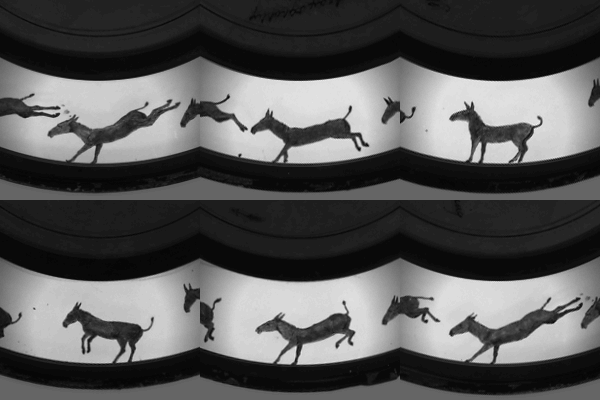
Through the ages, tools have dictated the development of content: the printing press led to books, the zoopraxiscope led to movies, the camera to photography, and so on.


From Wikipedia under Creative Commons License

But it's important to remember that the tool is nothing without the content it provides. And as authors, who are the creators of content, it is our role to shape the future that these tools are set to deliver.

Some are already experimenting with the new media available - the Japanese download text novels on their mobile phones, today I heard about augmented reality picture books, and authors like Kathleen Duey are experimenting with twitter novels and short stories (an aside: this is not new media, but has anyone listened to the BBC's Out Loud archive of poets performing their own work? Brilliant!) ...

Deep Love, the first ever cell phone novel

I've been following the Twitter short stories that author Melvin Burgess (my review of his book Nicholas Dane here) has been posting.

Melvin Burgess. Photo by John Coombes

They are odd, poetic and strangely affecting. Melvin says they are "not to everyone's taste" but there's something compelling about them.
I was just mucking around – trying out Twitter and wondering what tweets were. Of course, all a tweet is, is a not-too-long sentence – but I was thinking of them of having some particular quality to them. Then one day I came up with the sentence – You're pushing a pram down the road. An old lady looks inside and says fearfully, "Your babies are not human."

It reminded me of something I used to do years ago, while I was learning how to write – I’d sit down in the morning and just launch off with a sentence – anything, like they used to make us do in school – and just see how it went. So I thought I’d try the same thing here. That was the first twitter story, The Dancer. I’ve kept it up because the results are surprising and interesting – and because after writing novels for so many years, it’s a real reliefe to do something that can just take me wherever it wants to go. It’s fun.
I think the Twitter Tales are exciting (and surprising is a really good word for it)... but since I don't like to stay connected to Twitter all the time, I have to go back to his website to catch up. Says Melvin:
Twitter is bad place to post stories because they go up backwards and people find it difficult to keep up with them. I think a lot of people, like you, went to the website to catch up, so lately I’ve been trying posting links on my website. It makes them easier to read, but I don’t think it gets so many people’s attention.
Indeed it's very tempting to explore these new forms. When I first heard about Japanese text novels I was sorely tempted to try and write one. It's funny how the limitations of a form seems to promise endless possibility! It would be, as Melvin says, Good Fun (if, that is, you like to write).
Various people do story telling on twitter – many try to make a story out of a single tweet, which is another thing altogether. I’m not aware of anyone doing exactly the same thing though. And yes, it certainly is satisfying – I love it. I’d really recommend it to anyone who likes to write – it’s a really liberating way to work. So far, most of them have turned out kind of OK, but I’d be quite happy to ditch one if it turned out duff. No pressure – good fun. And the fact that you do it one sentence at a time makes it easy to write, somehow.
There is a poetic quality to the stories ... like a novel in Haiku form. Says Melvin:
I do like the final product, although I think they still need a bit more work. One day I’ll go through the best of them and polish them up, As for story I  like this as a form – well, maybe it’ll turn out to be something, I’m not sure. It is, as you say, poetic – a kind of free form narrative poetry, in a way. Whether or not it’ll catch on is another matter, but one, day, I’m sure I’ll use them for something. Maybe I’ll get them set up as Apps for iPhone or something like that …
Funny, that. I've been researching how to produce freebies for punters to download on my site ... all those picture books I've written that nobody seems to want to publish - I want to produce little e-books to give away to be read on mobile phones and Gameboys. But it's a bit beyond my technical ability (for now).

I asked Melvin what his Twitter short stories are telling us about technology and its impact on culture.
It isn’t just Twitter – everyone is running around trying to find out how they can use new media to tell stories. It’s an exciting area because no one knows how it will turn out. I did a TV and online project for BBC Switch a while ago called The Well, that had a big online element – a game in which new areas of drama were hidden. That was interesting too. The programme maker, Conker Media, is very much at the forefront of using new media for broadcast and online and I hope to do more with them. It’s something every writer should keep an eye on.
Still from The Well

Screenshot from The Well game

It's a brave new world out there for authors. What's next?
Who knows? I hav a couple of online projects I’m having meetings to develop next month. There’s possibility as well that we might try to film one or two of the twitter tales. Interesting times we live in!
Interesting times indeed.

Friday, 6 November 2009

John Green is Doing NanoWriMo!

... and John says:
"Nanowrimo forces the writer to be disciplined and gives the writer permission to SUCK!"


If you can't see the video go to YouTube

Monday, 2 November 2009

A Return to Shamelessly Promoting my Writing Friends

Time for one of those apologies.

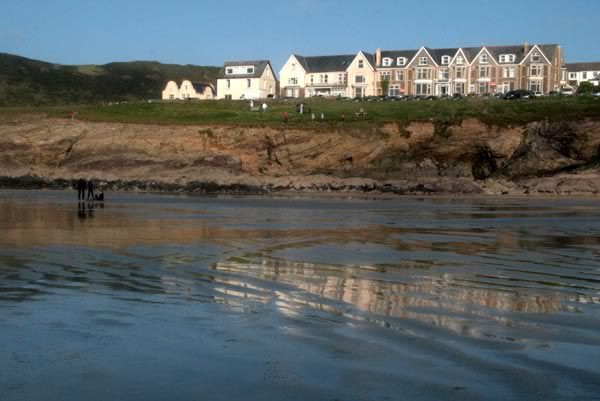
Yeah. I've been neglecting the blog. I've kind of been busy looking at this:


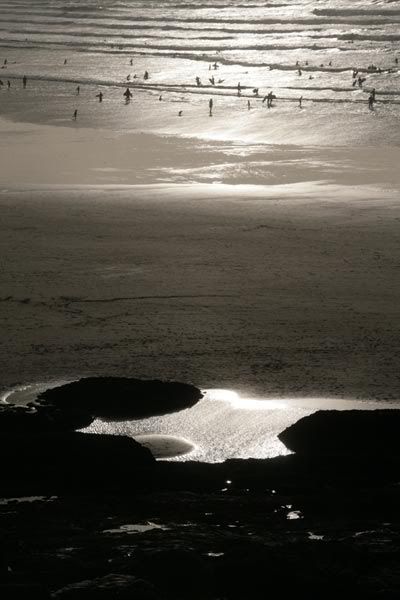
And this:

Yes, it was sunny in Cornwall. Yes, this was taken in October. Climate change, wouldn't you know? And that climate change anthology Under the Weather featuring my story is now available on Amazon! But that's another blog post ...

As a result, I've neglected an opportunity to shamelessly promote the successes of my friends (what else is a blog for but to shout on behalf of your cohorts?).

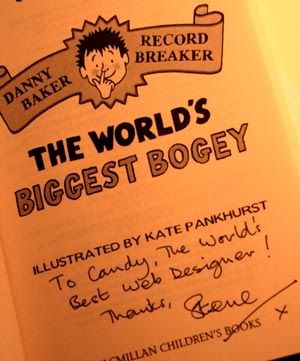
Anyway, my friend Steve Hartley recently treated me to a proof copy of his first Danny Baker Record Breaker book (out in January) - with this brilliant dedication:


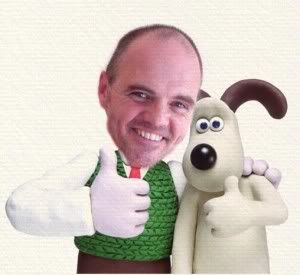
I don't think I am the world's best web designer, but hey, I'm a dab hand at Photoshop ... check out Steve all decked out in Leonardo di Caprio's body:


and posing with his hero, Gromit:


Check out Steve's website to see him in the bodies of John Cleese, William Tell and Russell Crowe

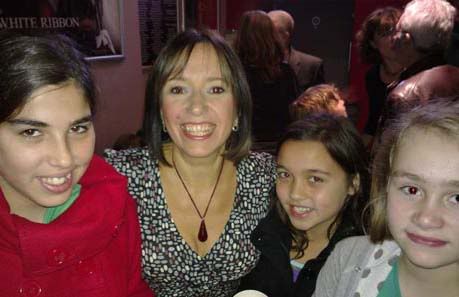
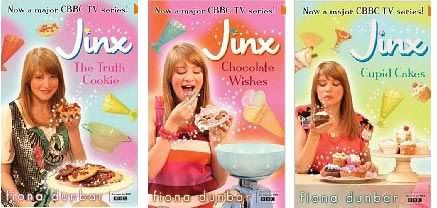
And then of course I should have been shamelessly promoting the launch of a TV series based on my friend Fiona Dunbar's wonderful Lulu Baker trilogy. Conveniently, an advance screening was held just up the road from my house and so I took my gang along to watch. Here's a picture of Fiona with my girls:


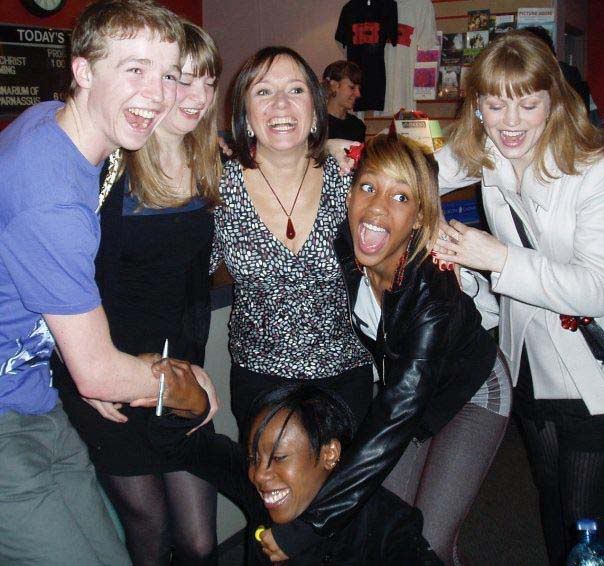
And here's Fiona with the lovely cast (note, the lady on the floor is Chizzi Akudolu who plays the fairy godmother - someone to watch: such a funny woman!)


My gang, by the way, are hardened followers of Fiona's books. They enjoyed the screening massively but were dismayed to discover that Fiona's carefully crafted baddy Varaminta (gold-digger and author of the deliciously titled bestseller Thin Like Me), had been converted from wicked-stepmother-to-end-all-stepmothers to a loveable wrongheaded marshmallow with a different hairdo per episode.

So much so they cornered the actress (she's the one at far right in the pic of Fiona with the cast) and demanded to know WHY VARAMINTA WASN'T BAD ANYMORE? The actress (I foolishly forgot to write down her name, for which, sorry!) was very accommodating and kindly explained that Fiona's trilogy had a beginning, middle and an end whereas the TV series would have to carry on and the character had to be reimagined for that purpose (as an author I was secretly chuffed to see they were so attached to the book!)

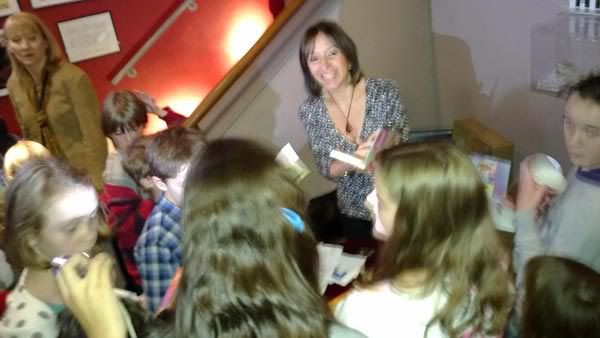
After the show, Fiona was mobbed, mobbed! for autographs! Wow!


I suppose one could call it, Fiona's Madonna moment ..


Glory! Fame!

And now they've reissued the books with new covers based on the series! OMG.


Way to go!

(Well, I've got a way to go ... but you guys are definitely on the right track!)

Jinx's first episode aired on CBBC on 31st October, Halloween at 10.30am. If you're based in the UK, you can view it again on the BBC iplayer - episode 1 Baker House Blend and episode 2 Dead and Butter Pudding  (the Halloween episode is great!)

Saturday, 29 August 2009

What happens when authors become cool online personalities

Not that YA author John Green (Paper Towns, Looking for Alaska) is a cool online personality only because he's trying to sell his books ... but look at what he got from his social network on his birthday -


And here was John's response:
If you can't be arsed to view the entire video, here's the most important thing John said:
People didn't make those songs or artwork or pictures and video clips in order to become famous or rich. They did it, to quote William Faulkner, "not for glory and least of all for profit but to create out of the materials of the human spirit something which did not exist before."
Mmmm. Human spirit.
He also said:
Every single day I get emails from aspiring writers asking my advice about how to become a writer. And here is the only advice I can give: Don't make stuff because you want to make money; it will never make you enough money. And don't make stuff because you wanna feel famous because you will never feel famous enough. Make GIFTS for people. And work hard on making those gifts so that people will notice the gift and like the gift. Maybe they will notice how hard you worked and maybe they won't. And if they don't, I know it's frustrating. But ultimately that doesn't matter because your responsibility is not to the people who notice but to the gift itself.

Wednesday, 26 August 2009

Where is the hope in children's books?

Someone mischievous organised the Compelling Novels, Vulnerable Children panel for the Edinburgh Festival.

On the panel were children's authors Melvin Burgess and Anne Fine.

Melvin Burgess Anne Fine
Fine, who was children's laureate from 2001 to 2003, famously lambasted Burgess in 2003 when his book Doing It was published, denouncing his publishers for -
... peddling this grubby book, which demeans both young women and young men? It will prove as effective a form of sexual bullying as any hardcore porno mag passed round. Read Anne Fine's 2003 Review of Doing It
I remember the review created a vociferous debate in the then nascent children's book blogosphere, with bloggers divided between supporting and resisting Fine's points of issue.
At the Edinburgh event, Anne Fine (Madame Doubtfire, Eating Things on Sticks) is reported to have deplored the gritty realism of modern children's books. I wasn't there so I can only point you to the reports in the Times, the Telegraph and the Mail on Sunday. And here is a discussion amongst a small group of authors on the Awfully Big Blog Adventure, after a post by Anne Cassidy (Looking for JJ).
This is what Anne Fine is quoted as saying:
Books for children became much more concerned with realism, or what we see as realism. But where is the hope? How do we offer them hope within that? It may be that realism has gone too far in literature for children ...
-------------------------------------------------------------------------------------
Update (29 August 2009): there was a lot of vehement reaction to this quote - Anne Fine sent out the following correction via some writer's message boards (emphasis mine):
Contrary to press headlines, I neither 'deplored' the lack of happy endings, nor asked for a return to Blytonish books. In a wide-ranging discussion with social workers and carers in a session about Fiction for Children in Care that was chaired by Children in Scotland, I simply wondered aloud what the effect of the new wave of grimly realistic books without those old-fashioned happy endings might be on those of our children whose lives they often mirror so closely, and asked the very experienced audience what they thought - and indeed whether their clients ever read the books. As someone who has myself written some quite tough books I would not ever do anything so simplistic as 'call for happy endings'. I recognise as well as anyone what a broad church children's literature is and must be.
Many thanks to Teri Terry who passed this on. And many thanks too to Anne for the clarification. I hope she's happy to have sparked a lively conversation amongst people who care about children's book. It certainly is a conversation worth having and I will always, always as a result ask myself when I'm writing - where is the hope?
-------------------------------------------------------------------------------------

To be fair, I have read a number of children's books, especially for teens, that made me wonder at the bleak, hopeless vision of the author. There are some books I would not recommend to my teenage friends. So I can see where Fine is coming from.
But I have read far more books that, while set in the grit and pebbledash of realism, radiate with a shining something that resists the generalisation.

The fact is, thanks to the New Media revolution, our child readers are far more aware of the darker side of life than their predecessors in Enid Blyton-reading times. And while there are still plenty of us who write the fantasy and adventure that can remove them from reality, we are still beholden to create stories that tap into our readers' experience and world view.

But it's a tough world out there. And I agree with Anne Fine: for children, books must be a haven, a place where there is hope.

So what is this shining something that can lift us authors out of the temptation to mirror the world in all its relentless hopelessness?

Funnily enough, it was something Fine's old adversary Melvin Burgess said that gave me an answer.

As you may know I recently attended a writing for teenagers week with Arvon, with Melvin Burgess and Malorie Blackman as tutors.
One of the most resonant pieces of advice I came away with was actually given to a colleague who had written a gritty novel about a deprived, self-harming teenager. I think my colleague had a conversation with Melvin about how you couldn't just dish out a relentlessly grim story. You had to temper it with something.

Melvin told her (and I paraphrase here inaccurately) that the important thing in such a piece of writing is to make sure the human spirit shines through.

Human Spirit.

Driving back from the course for three and a half hours on the M1, we were so inspired by the idea, we couldn't stop discussing it. What is human spirit? Does our writing have it? Where does it come from? How do we make sure it shines through in our stories?

Human Spirit. That's where the hope is.

Update: the third author on the panel was Rachel Ward (Numbers). She has since commented about the event on Keren David's blog post about the event. See her comment here. I just found out that Melvin Burgess has a new blog. Here is his bird's eye view.
--------------------------------
Some "realistic" books I have read that for me strongly evoke the human spirit (in no particular order).

How I Live Now by Meg Rosoff
A Swift Pure Cry by Siobhan Dowd
Finding Violet Park by Jenny Valentine
Solace of the Road by Siobhan Dowd
Ways To Live Forever by Sally Nicholls

... do add your own books in comments - i can think of more but I'd love to hear yours.

Sunday, 2 August 2009

Arvon's Writing for Teenagers Course with Malorie and Melvin

Painting of Lumb Bank
This painting of Lumb Bank was hanging in my room

Just got back from Ted Hughes' house on Lumb Bank five days with 16 other writers interested in writing for teenagers - 16 rather GOOD writers, I hasten to add. One of my fellow students was 17 years old, still a teenager herself, possibly the next Zadie Smith if she decides this is her thing.

I thought Lumb Bank was in the Yorkshire Dales but it turned out it was just East of Manchester, up the M1 and turn left, through Halifax and up some hilly bits. Miriam drove (thanks Miri!).

Benches, Lumb Bank
We were told to look out for these benches at the top of a little lane
Candy Gourlay. Lumb Bank.
We stopped for pictures before winding our way down the hill.
Ted Hughes Centre. Lumb Bank.
This was the bit of the house looking down a hill at a magnificent view, with disused mills, woods, and a river.
Ted Hughes Centre. Lumb Bank.
I had room number one at the top of the stairs.
Our tutors for the teenage writing week were Melvin Burgess (Junk, Nicholas Dane) and Malorie Blackman (Noughts and Crosses, Double Cross)
Melvin Burgess. Lumb Bank. Malorie Blackman. Lumb Bank.
Malorie and Melvin.
Melvin and Malorie alternated mornings teaching us about plot, character, dialogue with writing exercises that started out at 10 minutes each and by the last day was reduced to three minutes each ... they didn't want to give us the chance to think, to resist, to give up. We submitted samples of our writing to M&M and had one-on-one meetings with each of them in the afternoon to discuss our work and prospects in publishing.
Lumb Bank class.
We sat around a massive table
Lumb Bank.
View outside door as we worked on a rare sunny day.

Malorie made ALL of us read, recalling one tutor's sage words in the early days when she was reluctant to share her work :
Tutor: Malorie do you want to be a writer?

Malorie: More than anything else in the world.

Tutor: Well You’ve got to shit or get off the pot.

The sunshine on the day we arrived turned out to be a red herring. The heavens poured throughout the week. On the few hours when there was no rain, some of us managed to go for walks and visit the nearby village of Heptonstall where Sylvia Plath is buried in a sad, untended plot adorned with tacky souvenirs from her fans.
Lumb Bank.
A rare sunny day.
Heptonstall Village.
The Village of Heptonstall.
Ancient tombstones in Heptonstall's churchyard.
Ancient tombstones laid out in the churchyard.
Sylvia Plath's headstone
Sylvia Plath's headstone. (my camera mysteriously switched to monochrome)

It was a heady week for me. I'd been deep in the mangle of making a living and writing had not been coming easily. Melvin and Malorie opened my rusty tap and allowed the words to flow.
Rainy.
It poured again on the way home.
Welcome home.
Never mind the rain, my homecoming with all the children tumbling all over the bed was fantastic.
My suitcase was several books heavier after the trip. And I take heart from these words of encouragement from Melvin.
For Candy: Nearly there? Keep on writing, Melvin.

Slushpilers go to Arvon!


Share buttons bottom

POPULAR!