By
Nick Cross
 |
| Click any photo to enlarge it |
In last year’s blog post
Coming Out, I revealed the fact that I wanted to upgrade myself from writer to writer/illustrator. Amazingly (to me anyway), it’s been six months since I posted that, so I thought I’d give you an update on my progress.
The title of this post describes my state of mind through much of the last half year when it came time to pick up a pencil or paintbrush. But I’m pleased to report that the terror has mostly subsided. When I sat down last weekend to create the hand-drawn parts of the image that headlines this post, I even managed to enjoy the process.
This enjoyment is either despite or because of the trial-by-fire that was the Beginners’ Drawing and Painting evening course I joined in September last year, which sped through various disciplines so fast that I almost got whiplash.
We began with gouache painting, which wasn’t an ideal starting point for a complete novice like me. In fact, everyone who I’ve mentioned this to has said “Why didn’t you start with basic drawing skills?” And truthfully, I have no idea - that was just the way the art teacher liked to do it.
To be fair, we did begin with a drawing, a big sketchy sketch on A2 paper to get the composition right. Knowing my control freak ways, I tried to be all loose and expressive with this and it actually didn’t look too bad. Then we started painting over the top, which is where I started to come unstuck. I’d never realised how HARD it is to mix paint. It feels like constantly chasing an impossible goal, adding first one colour, then another, then yet another. And then, once you’ve finally attained a rough approximation of the colour you want, it runs out halfway through the painting and you can’t remember how to mix it again!
The teacher had advised us that we
could buy an expensive set of gouache paints costing £25, or go for something cheaper. I bought a Daler-Rowney set for a tenner, and sadly, it was rubbish. The paints came out of the tube all blobby (making them even harder to mix) and the coverage of my paint on the paper was a lot poorer than the other students. This was my first lesson in the quality of art materials - although two tubes of paint may look exactly the same, there’s a genuine reason why one costs twice as much as the other.
I also got tripped up by the quality of my initial sketch. Although it was impressively loose, there wasn’t enough detail in places to do justice to the subject. This is another big lesson for me - I’m not great at freestyling yet, so my finished picture is only ever going to be as good as my underlying pencil drawing.
OK, enough caveats - here is my finished gouache painting:
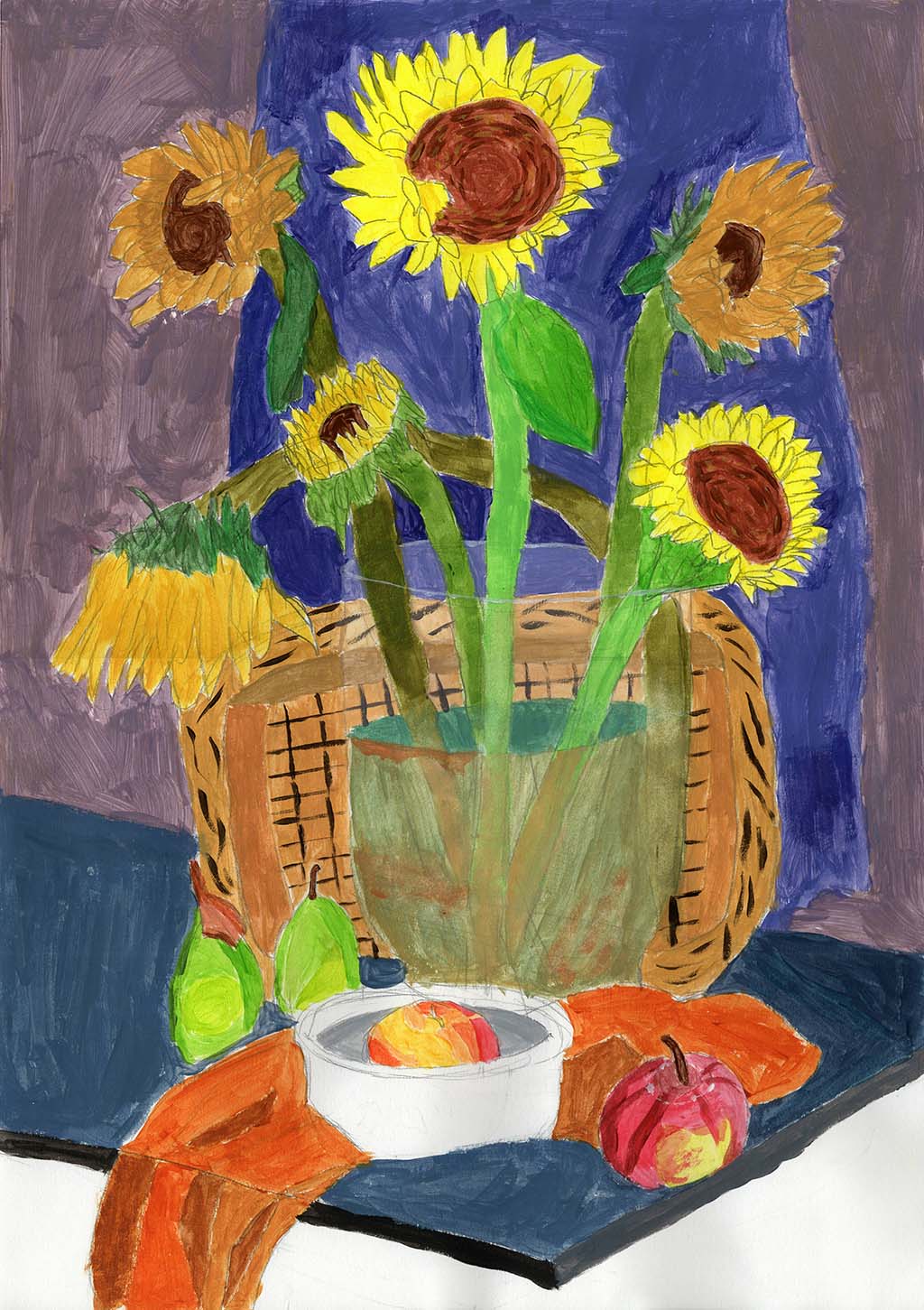
That strange brown thing behind the vase is a basket, BTW...
Next up was a tonal pencil drawing, and the one part of the course I really enjoyed. I had looked for an art course that was for drawing only, but had struggled to find one in my local area that wasn’t at 2pm on a weekday afternoon (for retired people, I assume). Although I found pencil drawing a real technical challenge, at least there was no colour mixing involved! Cross-hatching and shading were two concepts I was very aware of, and very aware that I didn’t know how to do them. There was a magical moment in the second week when everything just clicked and I could suddenly see (and reproduce) tonal range.
The drawing was another A2 composition, which meant a lot of paper to cover and a lot of graphite to accidentally drag the heel of your hand through. I’m very detail-oriented, so working at A3 is probably a better size for me. The teacher insisted on putting another blimmin basket in the still life, though I managed to render it rather better than last time. Overall, I’m very pleased with the finished result:
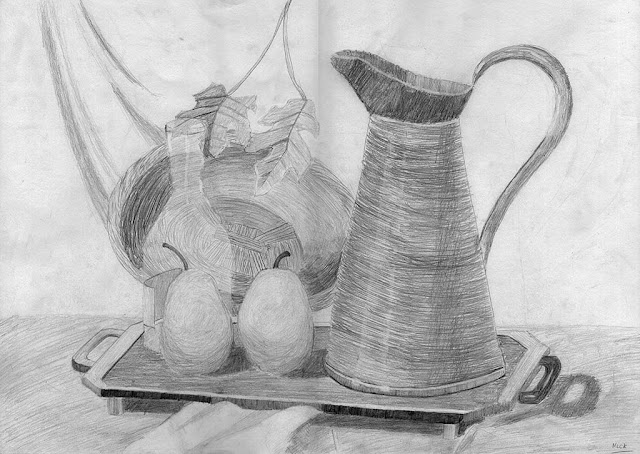
This used a range of pencil grades from HB to 4B. Another lesson I learnt (albeit one I should remember from primary school) was that pencils can be difficult to make really sharp without breaking the lead. If you’re not careful, you can quickly end up with just a stub! To avoid this problem, I’ve started using a mechanical pencil with 2B leads for most of my sketching.
The final task of the term was executed in an unusual hybrid of white gouache plus pen and ink. When asked what the style was called, the teacher replied “Oh, I don’t know. I just made it up.” This was typical of her somewhat “artistic” approach to the class. Rather than show us how to do a particular technique, she liked to throw us in at the deep end and see what we produced. As a total novice, I would have preferred more structured guidance, and found that I was constantly behind everyone else, struggling to catch up. I also found the two and a half hour session much too long to maintain such an intense level of concentration. When I’m working at home, the length of an album (around 45 minutes) is about the right amount of time to spend before I take a break.
We were using a dip pen and various coloured inks, which caused technical problems because of the variable quality of the nibs and the viscosity of some inks. Although it’s an expressive medium that allows variation in line width, working in pen and ink did make me yearn for some nice black fineliners. The subject was yet another still life - by this point, I was a bit bloody fed up of these!
The finished result remains, um, unfinished, because we ran out of time. And I’ve not yet felt motivated to buy inks and a dip pen to finish it:
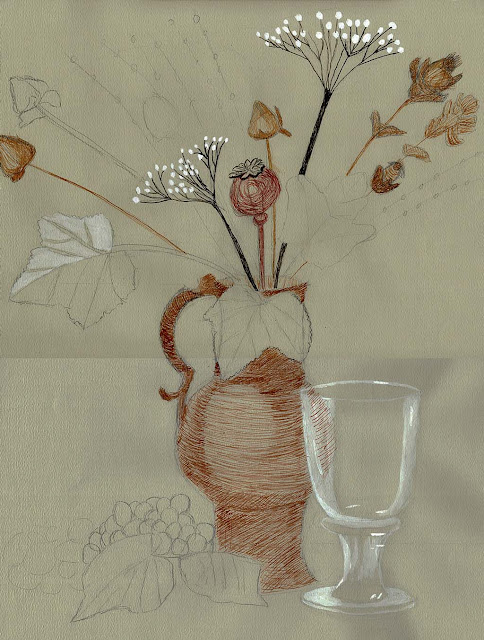
Overall, my experience on the first term of the course was mixed. Although I made a lot of progress, it was not a pleasurable experience - I felt anxious and out of my depth most of the time. Just the fact that I didn’t bolt from the room screaming was an achievement. I learnt that I need space and time to do my best work, drawing little and often rather than trying to get everything done in a hurry.
This A3 drawing of a Star Wars X-wing is something that wouldn’t have been out of place on twelve-year-old me’s bedroom wall, if I’d been able to actually draw at that age. It’s also the first independent project I completed after the course ended. I think it's safe to say that I'm no longer a stranger to cross hatching!
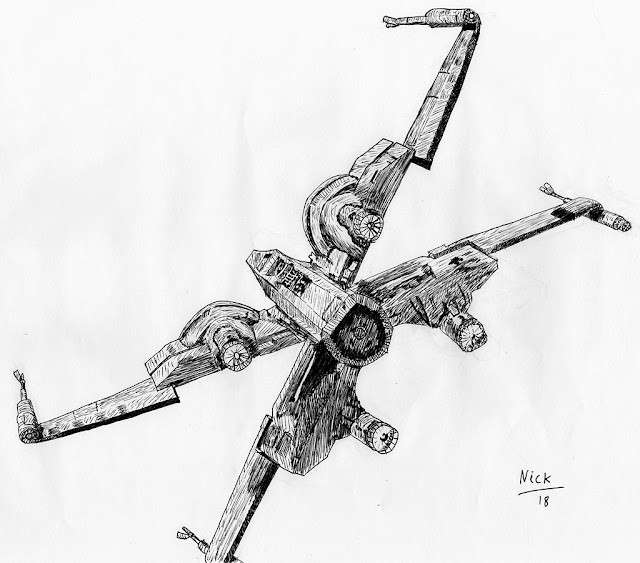
No dip pens here, just an excuse to use the pack of various width fineliners that called to me from the shelf at WH Smith. Indeed, I’ve had the opportunity to amass a lot of art materials over the past half year. My previous marker pen obsession has grown to epic proportions, as this photo demonstrates:
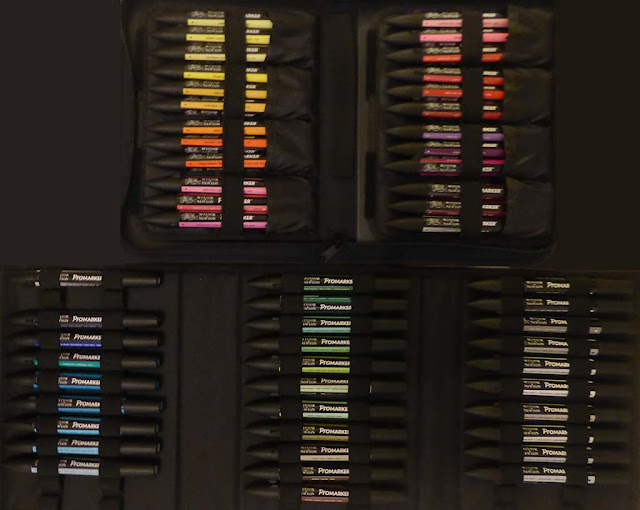
As a writer, I have never been into exciting stationery, preferring a plain A6 notebook and a Bic biro. Clearly, the illustrator side of my personality is very different!
Finally, a quick progress check. At last year’s SCBWI Picture Book Retreat, we were given a postcard and asked to list our three goals for the forthcoming year. Here are mine:
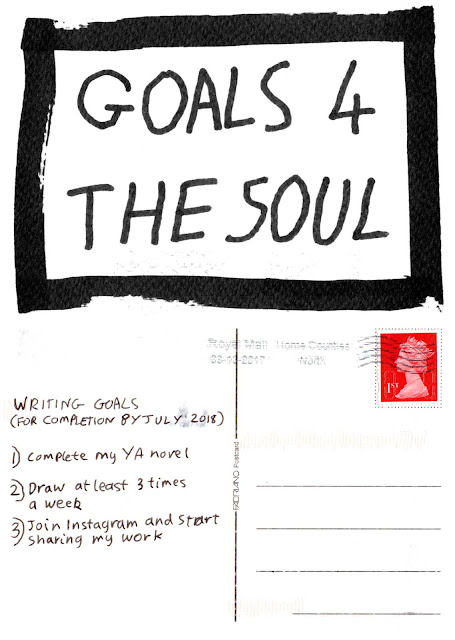
1) Getting there. Thanks to this goal, I’ve set a target of the end of June to complete the manuscript.
2) Big tick. Some weeks recently, I have been drawing every day!
3) Eurgh - wish I hadn’t set this one. I look on Instagram and I think - “Why am I bothering when everyone is so much better than me?” and “Do they really have to use that many hashtags?” Expect me to join Instagram very quietly the day before this year’s Picture Book retreat.
So what’s next? Well, despite my nerves, I went to the SCBWI illustrators’ meet-up in London this week and had a good time (thanks to Louise Gilbert for organising that). As you’ve probably gathered, I haven’t returned for the second term of the evening class. Instead, I’ve signed up for an even bigger challenge: a course in picture book illustration with superstar illustrator
Korky Paul! But more on that in a future post...
Nick.
Nick Cross is a children's writer/illustrator and Undiscovered Voices winner. He received a
SCBWI Magazine Merit Award, for his short story
The Last Typewriter.
Nick is also the Blog Network Editor for SCBWI
Words & Pictures magazine. His
Blog Break column appears fortnightly on
W&P.


