Notes from the Slushpile is a team blog maintained by eight friends who also happen to be children's authors at different stages of the publishing journey.
Not to get too morbid here, but it’s definitely going to happen that you’ll stop writing at some point in the future. Either through disease, or death, or taking up some exciting new hobby like competitive topiary. Would the knowledge that you’re writing your last book help or hinder your current work-in-progress?
Eight years ago, I became convinced that the book I was writing would be my last. My magnum opus. Of course, it didn’t help that I was suffering from a serious mental illness and feared that I might die at any second. Or that I felt my agent at the time was pressuring me to finish the book so we could get it out on submission. Anyhow, I pushed and struggled my way through that novel, with a weird mix of fear, self-hatred and messianic overconfidence.
Looking back, I’m not sure how I got through that period. What I really should have done is stop writing and trying to get published, because that was part of the reason why I got sick in the first place. If I’d had more of a flair for the dramatic, perhaps I might have taken my own life after typing THE END. I certainly had plenty of suicidal thoughts to work with. But somehow I clung on, through the disappointment of my agent rejecting the book, through me leaving her and the book failing to find a publisher (thought to be fair, it hardly had a fair shot as I only sent it to three editors).
I was wrong about a lot of things from that period, not least that it would be the last book I’d ever write (I’ve written another four since then). But something has kept pulling my thoughts back to the novel I’d written during that dark time, a feeling of unfinished business. Was it still the masterpiece I’d imagined it to be?
Well, no.
It isn’t bad, actually, but it definitely isn’t world-changing in its current form. They say that you should leave your manuscript in a drawer for as long as you can to get a fresh perspective on it, but I’m not sure they were thinking about eight years! Still, I’d recommend it if you feel you can spare the time. With the benefit of hindsight, I can see now that it’s just a book, something that can be revisited and moulded into a different form. With the guidance of my new (and much nicer) agent, I’m doing just that, rewriting it as a graphic novel. The rewrite is still not an easy process, but at least there’s a lot less drama this time around.
It’s fascinating looking back at my life and work from such a distance, seeing how much my mental state bled into the characters I’d created. The protagonist is burdened by massive guilt and self-loathing, putting himself in dangerous situations in the hope he might be set free by death. Medication to control behaviour is everywhere. Even the overriding concept of the novel is an elaborate metaphor for depression.
If the novel I wrote reflected the man I was then, the new version will surely reflect me now – older, somewhat wiser and definitely more cynical. It’s ironic that we’ve just gone through another period of maximum fear and loathing during lockdown, a period that was not helpful in the least to my creative process, and during which I wrote very little. It’s only since the emergence of a tentative new normal that I’ve been able to start moving forward on the book again, to recognise the kind of persistent, low-level depression many of us have been suffering from in the last few months. And with that realisation comes the uncomfortable truth that I will never be truly free of mental illness, just better able to recognise and control it.
There’s an argument that knowing you were working on your final book wouldn’t change anything, because to write successfully you must pour the whole of yourself into the work, holding nothing back. And while I understand that theory, it also puts a hell of a lot of pressure on you as a writer, denying you the space to experiment and make mistakes. By all means, write your heart out and leave an amazing legacy of work for future generations. But don’t forget to be kind to yourself and others while you’re still here.
Nick.
Nick Cross is a children's writer/illustrator and Undiscovered Voices winner. He received a SCBWI Magazine Merit Award, for his short story The Last Typewriter.
Nick is also the Blog Network Editor for SCBWI Words & Pictures magazine. His Blog Break column appears fortnightly on W&P.
I am ready to write this thing and remind myself of that quote from my new favourite screenwriter Greta Gerwig:
"You have to will it into existence because no one needs it until they know they need it."
This is what I'm gonna do today: will my story into existence.
But then I go downstairs and mop the floor.
Sounds familiar?
The good news is, I know I am not alone. All I have to do is check my Twitter / Instagram / Facebook feed ... and there they are, all my writing friends, in various stages of procrastination. It's a wonder that anything gets published at all.
If we're all procrastinating, is this a normal thing? And if it is, how do we avoid it?
Apparently screenwriter Aaron Sorkin likes to say:
"You call it procrastination, I call it thinking."
Hmm. Somehow when I'm giving those skirting boards one more polish, it doesn't feel like thinking.
He says it's like there are several characters fighting over the steering wheel to your brain.
One is the Rational Decision Maker, who can visualise the future, see the big picture, make long term plans.
Unfortunately, the other character is the Instant Gratification Monkey, who lives in the present moment, has no memory of the past and "only cares about two things: Easy and Fun".
Explains Tim: "The Rational Decision Maker will make the rational decision to do something productive. But the monkey doesn't like that plan. So he takes the wheel and says, 'Actually let us read the entire Wikipedia page of the Nancy Carrigan-Tonya Harding Scandal because I just remembered that that happened ... then we're gonna go over to the fridge and see if there's anything new in it since ten minutes ago.'"
Then there's another character: the Panic Monster. The Panic Monster is in hibernation most times, but emerges in a frenzy when there's a deadline.
Panic is the only thing that can scare the Instant Gratification Monkey away from your brain's steering wheel.
But what if you have to go sit in your garrett (without anyone nagging you to do it, of course) and come up with fresh chapters time and again. How do you fight procrastination when, like many of us, you are still – in Greta Gerwig parlance – willing into being a novel that nobody is waiting for?
(Though this is a bit of a rhetorical question for me as my publisher is DEFINITELY waiting for me to finish writing my novel – yikes!)
Tim says creativity takes emotional and mental toil over time. "Procrastination forces you to slow down, which is why it can be a direct asset."
SLOWING TIME
Procrastination, an asset? Say what?
"If you really stretch time a bit and go deep into something, it gets more and more interesting, the deeper you're into it."
This is Tomas Hellum, a Norwegian TV producer who came up with Slow TV, streaming hours sometimes days of television.
Notes the New Yorker: "Most art, even the naturalistic stuff ... comes in espresso form: the complexities of human perception are picked when ripe, roasted to intensity, milled, tamped down, and infused into something that’s quickly consumed. It is surprising, then, to find a challenge to this ancient premise arriving in a novel entertainment form—suddenly everywhere—known as 'slow TV.'"
But Tomas insists that this is precisely what people need. "We are living in times when coherent stories and context is somehow exotic. People are longing for some kind of connection or an unbroken story."
"Slowness gives you the ability to take back some control."
What we write has to compete with the bite-size snacking offered by social media, which has regrettably come to define leisure expectations around the world – entertain me with something easy, quick, disposable.
It's becoming harder and harder to hook readers into long reads, harder to persuade them to invest time and emotion into stories that require concentration and time.
So the idea of Slow TV gives me hope for my art.
But this is by the by. It's not just the consuming of art that needs to slow down, but the creating of it.
NO RUSHING
Have I mentioned that Greta Gerwig is my new favourite screenwriter? Watching her take on Little Women had me listening to every writing podcast I could find that featured her.
In The Q&A with Jeff Goldsmith, Jeff asked Greta about her process. Did she outline? Did she plan? How long did it take her to write her award winning films, Lady Bird and Little Women?
She said she keeps her writing "diaphanous" as long as she can, that she doesn't even put the manuscript in a screenplay form until much later because anything that looks final "gives you the illusion it's a final draft – it gives you a cosiness that you haven't earned" making it harder to change it. "I find when I outline before I write its the fastest way to kill all my ideas. It makes everything quite literal for me."
Screenshot of Jo March laying pages of her manuscript on the floor from the film Little Women
Writing is a messy business – documents everywhere, sheets in longhand, she even writes using a typewriter. "I write a lot of scenes, gather a ton of material. I write until it feels like I can see a shape to it."
Tacked above her desk is a sign:
DON'T BE AFRAID TO BE BORING.
"I got good advice at the beginning: write everything. Write the things you think might be boring because there might be something in it. I think sometimes, when you're writing you’re in such a hurry to entertain, you can miss something that could be fruitful.”
FYI here is Greta Gerwig's Annie Leibowitz cover for Vogue
"It’s not about output it’s about sitting with the problem. That’s the thing about writing."
PUT THINGS OFF
Hearing Greta explain that she is more interested in earning that final draft than writing it, is fascinating to anyone who feels the pressure to perform, especially in the children's book world, where your reader can outgrow you before you've finished writing a series.
American psychologist, Adam Grant tells the story of how Martin Luther King Jr was rewriting his speech until seconds before he took the podium before a 1963 civil rights rally in Washington, then leaving the speech in his chair to utter the words "I have a dream ..." which was not in the script.
"By delaying the task of finalising the speech until the very last minute," Adam says, "he left himself open to the widest range of possible ideas. And because the text was not set in stone, he had freedom to improvise."
Adam says we often misunderstand procrastination as laziness when it is actually discouragement that makes you want to flee a particular task. The danger is that the procrastinator might "rush ahead with their simplest idea because they didn't have time to work out their creative ones." But the non procrastinator is in as much danger of being less creative: "(non procrastinators) tend to rush ahead with our first ideas which are usually most conventional. We also make the mistake of thinking in very structured, linear ways."
In fact, says Adam, studies have shown that procrastination can boost creativity as long as it doesn't take too long. "People who started (work) early and then put it away for a while and then came back to it were more likely to do divergent thinking and incubation. Actually boosting their creativity."
BUT GRAPPLE WITH THE PROBLEM BEFORE YOU PUT IT OFF
We procrastinate because of doubt.
Self doubt - an inability to believe in yourself – can be paralyzing.
Idea doubt, though, the kind that makes me mop my floor instead of writing the next chapter, is different. It can be energizing.
Says Adam: "It motivates you to test, to experiment to refine, just like MLK did.
"Instead of saying I'm crap, you say the first three drafts are always crap and I'm just not there yet."
Like Greta Gerwig, we need to put off our final draft as long as we can, we need to earn it. Says Adam: "Procrastination can become creative when you've actively grappled with the problem".
There is actually a name for why we are advised to set aside a manuscript's first draft before attempting an edit. The Zeigarnik Effect – named for the German phsychologist who identified the process – describes how we unconsciously continue to work on incomplete tasks that we've set aside.
Explains Adam: "When you finish something, you check it off your to do list and it's erased ...whereas incomplete tasks ... Your brain continues to work on a problem, testing out different ideas" even as you are pursuing other activities.
TAKEAWAYS
I was inspired to write this after listening to the Ted Radio Hour Podcast on the theme Slowing Down.
We writers often talk about how showing up is half the battle of writing a novel. But how many times have I shown up and ... no matter how hard I stared at my screen, could not make my writing go to the next level ... then, after setting a project aside in despair, found myself refreshed, full of new ideas again?
I am always impatient when I write, wanting to churn out chapters quickly, religiously recording my word count, and hating myself when I fail to meet my objectives.
But learning about slowing down, thinking about Greta Gerwig's advice to "sit with the problem", I realise that I have known all along what gets my novels written.
I must turn up, yes. But I must also give myself permission to take time. Procrastination is taking time. It allows your brain to work on the problem. It's good for you, Adam Grant says, as long as you grapple with the problem first, and don't take too much time.
So I mustn't let it be a source of stress, but of creativity.
Besides, my house will be cleaner for it.
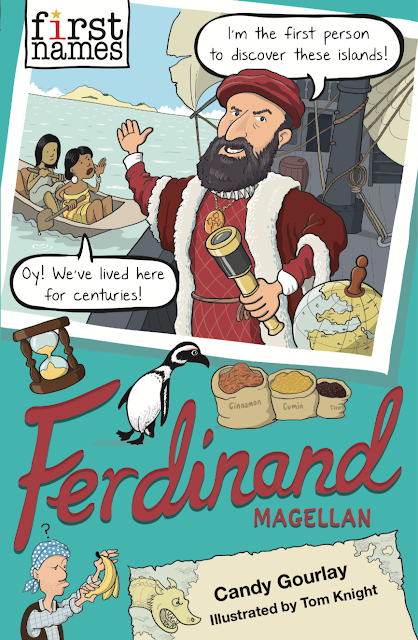
Candy Gourlay is the author of Bone Talk, which was shortlisted for the Carnegie and the Costa children's book awards. Her next book is a biography for young readers on the explorer Ferdinand Magellan. In the UK, it will be published in paperback by David Fickling Books this April. Pre-order here. In the United States it will be published in hardback by Abrams in September. Pre-order here.
One of the oddest things about how I ended up as a published writer was being picked up from a publisher's slushpile. Most writers go through an extended "nearly there" phase. They are shortlisted in writing competitions. They get full manuscript requests from agents. Then they get signed by an agent and go on submission but their story doesn't manage to sell. These are normal stages. Writers' successes usually come in tiny increments. Whereas I spent years and years writing with little sign that I was getting anywhere at all. Then suddenly - bam! Nosy Crow wanted to offer me a contract for a series.
But I think we can get too fixated on our destination as writers. We forget that any creative endeavour is a journey. We focus on getting an agent and getting a publisher. Of course these are important, but looking back they seem less important than they did at the time.
I think we can get too fixated on our destination as writers. We forget that any creative endeavour is a journey.
I started writing around age six when I invented a world of talking bookworms. I drew a map of their country in an empty exercise book and started writing down their adventures. I can't remember why I chose to write about talking bookworms. I suspect someone had told me that I was a bookworm and my brain had run away with the idea. Somehow in late childhood I lost the belief that I was able to write and, aside from some teenage poetry, I didn't return to writing until I was in my late 20's and by then a qualified primary school teacher.
A focus on readers has been a key part of my writer's journey. I spent years noticing how the children I taught reacted to stories. I noticed which books they picked from the library. I saw how they would return to a series or an author they loved over and over again. Then I became a parent and I got an even deeper insight into how children love stories and how they grow into readers.
Like all of us here on Notes from the Slushpile, finding SCBWI (the Society of Children's Book Writers and Illustrators) absolutely transformed my journey. Not only did I find a wealth of expertise and information through their events, but I also met lots of lovely writers and illustrators. Nobody can work and improve in a vacuum, and suddenly I had a huge source of inspiration and commiseration for every stage I went through. Whether I was at the peak of a wave or down in a trough there was always someone there with me.
Suddenly I had a huge source of inspiration and commiseration for every stage I went through.
Around 2009, I was just coming to the end of submitting what seemed like my millionth middle-grade book to an slew of uninterested agents and publishers, when my children started enjoying young series fiction. Tired and fed up of endlessly writing and submitting fiction for 9+, I started writing my own younger stories. It would be a break from longer books, I told myself, and I could finish the books faster and get rejected faster too!
I was spending every bedtime reading all sorts of stories to a five and a seven year old. Somehow, without realising it, I internalised the story structure and pacing for young fiction. Suddenly I had a contract for my first series - The Rescue Princesses. Writing younger books gained me my first publishing contract and several more since. But I have found that more than anything, I love the journey. Success is wonderful. But publishers and readers often want more of the same. Writers like to try something new! So how do we balance the needs of our readers and the market with our need to move on as writers?
Publishers and readers often want more of the same. Writers like to try something new!
I am still working out the answer to this one. I have been lucky enough to publish several middle grade novels as well as the younger fiction that gained me my first contract. Writing is my living so I am always balancing creative and commercial impulses. I always have readers in the back of my mind and I am always up for trying something new!
Paula Harrison has published over 30 books including The Rescue Princesses, the Red Moon Rising trilogy and the Secret Rescuers series. Her next book Kitty and the Sky Garden Adventure publishes Feb 2020.