Saturday, 8 August 2009

Digging Deep and Finding Your Heart Elsewhere

corazon aquino as Time Magazine's Woman of the YearI often write about digging deep — about scrounging around deep down to find you know, that essence of who you are, the thing that will make your writing really ring true, really sing.

Well, this week I dug deep and found that my heart was elsewhere.

In my native Philippines, it's been a traumatic week.

Corazon Aquino, the former president, died and there has been a great outpouring of grief and a mass recollection of the tumultuous revolution that catapulted this housewife (who looked remarkably like my mother) to power. She was a woman forced into a role she did not choose, inheritor of the shambles left by a 20 year dictatorship, a president of many imperfections. Her enforced leadership was no gift to this shy, unassuming woman.

My beloved former editor, Letty Jimenez Magsanoc, sent out a message to all us former staff writers now scattered across the world to send in our recollections of Aquino.

Living here in London as I do, I found it difficult to summon memories of that period. Was it the passage of time? Or had my brain grown fat in this country where freedoms are taken for granted, hunger is a concept, and people speak in complete sentences? It's all very well to talk about digging deep to my fellow writers. I had not kept a diary. What if I dug deep and found nothing?

My journalist friend Elizabeth recently wrote a piece for Granta on the conflict between memory and reality in her experience of the Tiananmen Square massacre
We take fragments of memory and weave them together into patterns as best we can. We darn or embroider any holes with threads of things that happened in our readings, in our conversations with others who really were there, in our dreams.Those then become part of the fabric of our storytelling, so that soon enough it is impossible to say what was remembered and what was embroidered. Read her essay here
I searched my photo albums and mementoes of the days leading up to and after the revolution of 1986. One thing is for sure, I took no photos. I had no film. I experienced history with an empty camera. And none of my photographer friends could risk their supplies and spare me a roll.

In the many photos, of the crowds, the journalists chasing the personalities of the day, I know where I am. I was standing on the other side of that tank as the nuns cowered under its tracks. I was on a balcony watching the helicopters descend on the military camp. I was sitting on the bridge as the people stormed the palace. But no, I cannot find myself in any of the pictures. It's as if I was never there.

I did keep the front cover of this magazine, not because of any historical significance but because smiling in the crowd was the face of my future.
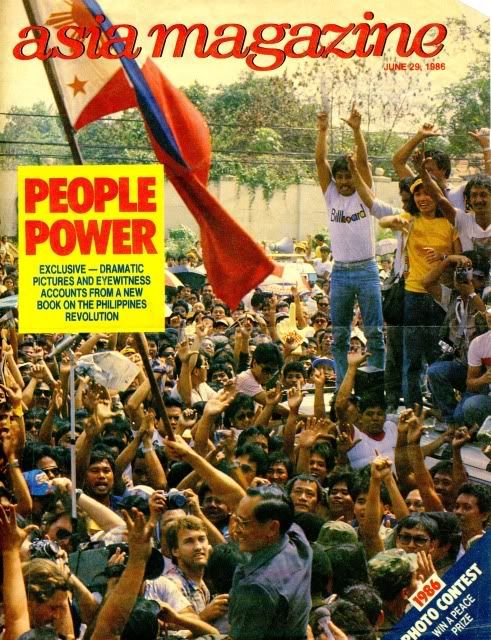
Cover of Asia Magazine featuring People Power revolution, 1986

But of myself and of my role, I have kept no mementos.

Except ...

The events of 1986 were a coming of age for me and though I forget so many of the details, I only have to reread the stories I have written, revisit the characters I have drawn, to realise that the story of Cory and the 1986 revolution are all there. In my writing.

The girl who yearns for her mother. The boy who realises that what he wants has been there all along. The burden of a wish come true. The blessing that turns out to be a curse. Love, loss, the struggle to understand what is right and what is wrong - the memories I thought I had forgotten are imprinted in my soul — and manifest in my storytelling.

This is what I find when I dig deep, and it all comes from the growing up I had to do in the era of Corazon Aquino.

I also found this:
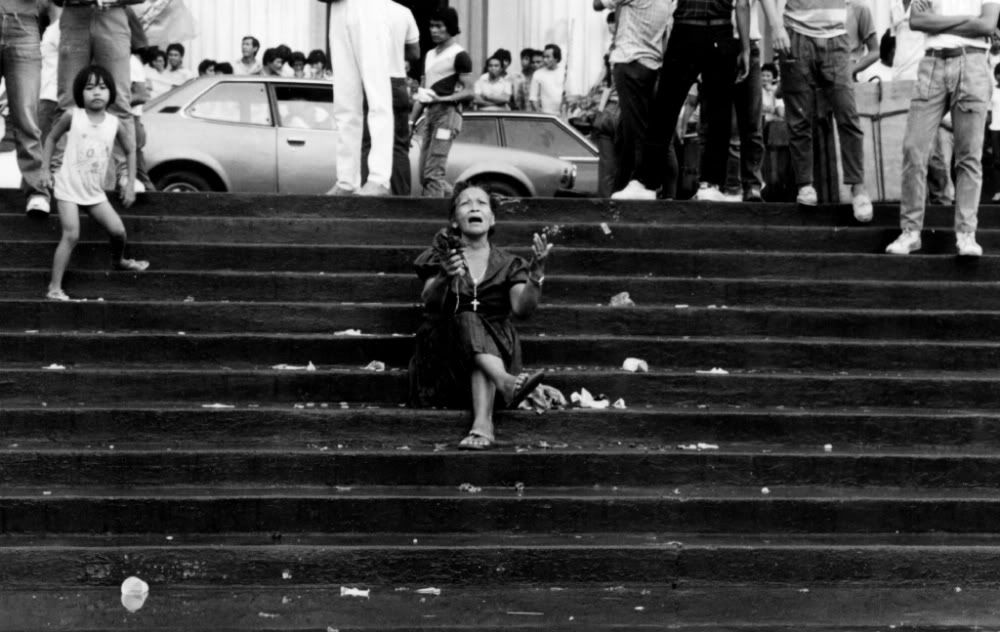
image of mad woman singing Bayan Ko on the steps of the Post Office, 1985. Philippines. Photo by Candy Gourlay.
I took this photo of a woman sitting on the steps of the Post Office in downtown Manila, after one of the frequent anti-government rallies of that time had dispersed.

She was quite mad, holding a plastic rose in one hand and singing in a strong alto Bayan Ko, the song that was to become the rallying anthem of that period.

She was somebody's mother, lost and unnoticed by the crowds.

In 2005, I did a radio programme about the migration phenomenon in the Philippines that has left so many families without a mother. The programme was called Motherless Nation.

I think the photo captures how many of us Filipinos feel now, after the death of Aquino, after all the things that have come to pass these last 22 years.

A nation, motherless.

Tuesday, 4 August 2009

Too much craft ... not enough story?

I was fascinated by blogging literary agent Rachelle Gardner's observation that lately, there have been some rather fine examples of writing craft on her slushpile. Sadly, story doesn't quite live up to technique.
In fact, just this week I read some sample chapters from a newbie writer, and I was impressed with the technical excellence. Nice dialogue, perfect POVs, showing not telling... But the story itself involved a hackneyed plot, a totally uninteresting protagonist, and major predictability. It felt like it was written by a computer program, and it made me sad. I want to teach writers to not only learn the craft, but to also write from their heart. Write with authenticity, write from the depths of personal experience. Read more
Interestingly, this is echoed by author Kathleen Duey (I just read her book Skin Hunger ... oola la, what a fabulous read!) in an interview on the CWIM blog --
Competent novels are harder and harder to sell, in large part because of SCBWI’s wonderful resources, more and more people can write pretty well. But I think too many of us learn the rules—which are far more “teachable”—and lose the spark—which is more “discoverable”. Read more
This past week I attended a residential writing course with authors Malorie Blackman and Melvin Burgess. M&M put us through three or four (THREE OR FOUR!) timed writing exercises everyday - at first giving us five minutes to write but eventually cutting back to just three minutes.
They wanted us to shoot from the hip - no time to think, no time to compose, no time to even contemplate failure. Just write with your guts.
I didn't think I could do it the first time they announced how it was going to be. But I was pleasantly surprised at how it seemed to shock the rust out of my writing gears. Boy, how we wrote! It really helped that Malorie could not resist calling out "one more minute!" just seconds into an exercise.
The exercises all had to do with character, plot, dialogue - approaching each item from every angle you can think of.
I can't share everything I wrote because the thing about not having time to think is you put down stuff that is personal at the very least and at its most dangerous, probably libellous. So rather than get sued by my close friends and relatives here arethree of my least offensive attempts:
Describe navy blue to someone who cannot see ...
You know navy blue, you know it. It sort of swishes underneath everything, dark and wet but warm. It makes other colours look better. Yellow, yellower. Red, redder. It’s not shy but it doesn’t try to step forward either. It’s like an old husband, there, in the background, outside the lamplight, and yet a perfect fit.
Describe rock music to someone who cannot hear ...
It gets behindyour eyeballs, rock music. Like one of those headaches that start at the base of your skull, throbbing behind your eyes. Except that it’s pleasurable. Most of the time anyway. It seizes you by the heart and squeezes, squeezes and it’s like your blood is pumping harder and harder and your brain is going to explode. It’s so hot and yet its so cool.
... And this next one probably set up a few of us for a life-time of therapy, when we were finished, we were all emotionally exhausted from exploring our regrets:
Write up an argument between yourself today and your younger self ...
(In which Now me blames Young me for wasting so much time)

Now me: Why didn’t you start earlier? Why didn’t you do the writing courses, read the books, actually WRITE for goodness sake? Why is it down to me to play catch up, to spend sleepless nights studying and reading and writing – being rejected, suffering the slings and arrows ---

Young me: You don’t remember do you? You don’t remember how hard it was?

Now me: You could have done some writing. There was time. It’s not as if you had to get that A in trigonometry. I can inform you now that I have never had to do cosines and sines and those equations of never letting go ... not once in my lifetime.

Young me: I didn’t have time. Remember M? She needed me ...

Now me: She didn’t. Look at how she’s turned out. She was always going to need you. She was never going to be satisfied all those if only you could do this for me, and if only you could do that for me. She never had any intention of making anything happen. Is she happy now?

Young me: Are you saying it didn’t matter? Looking after the boys, cooking and cleaning and spending al that time at home helping out . None of it mattered? I should have just let all that go and started writing?

Now me: Well, you could have given me a bit of a headstart.

Young me: I did. What are you writing about now? Are you writing about how you started writing earlier? No, all this stuff about belonging ... about loving ... about ... that’s all me. It’s not about YOU. It’s about ME.
Having said that, one of the most memorable lines from this exercise came from my colleague who was just 17 in which her Now Self chided her Young self: "You're just a child!" To which her Young Self replied: "So are you!"

Sunday, 2 August 2009

Arvon's Writing for Teenagers Course with Malorie and Melvin

Painting of Lumb Bank
This painting of Lumb Bank was hanging in my room

Just got back from Ted Hughes' house on Lumb Bank five days with 16 other writers interested in writing for teenagers - 16 rather GOOD writers, I hasten to add. One of my fellow students was 17 years old, still a teenager herself, possibly the next Zadie Smith if she decides this is her thing.

I thought Lumb Bank was in the Yorkshire Dales but it turned out it was just East of Manchester, up the M1 and turn left, through Halifax and up some hilly bits. Miriam drove (thanks Miri!).

Benches, Lumb Bank
We were told to look out for these benches at the top of a little lane
Candy Gourlay. Lumb Bank.
We stopped for pictures before winding our way down the hill.
Ted Hughes Centre. Lumb Bank.
This was the bit of the house looking down a hill at a magnificent view, with disused mills, woods, and a river.
Ted Hughes Centre. Lumb Bank.
I had room number one at the top of the stairs.
Our tutors for the teenage writing week were Melvin Burgess (Junk, Nicholas Dane) and Malorie Blackman (Noughts and Crosses, Double Cross)
Melvin Burgess. Lumb Bank. Malorie Blackman. Lumb Bank.
Malorie and Melvin.
Melvin and Malorie alternated mornings teaching us about plot, character, dialogue with writing exercises that started out at 10 minutes each and by the last day was reduced to three minutes each ... they didn't want to give us the chance to think, to resist, to give up. We submitted samples of our writing to M&M and had one-on-one meetings with each of them in the afternoon to discuss our work and prospects in publishing.
Lumb Bank class.
We sat around a massive table
Lumb Bank.
View outside door as we worked on a rare sunny day.

Malorie made ALL of us read, recalling one tutor's sage words in the early days when she was reluctant to share her work :
Tutor: Malorie do you want to be a writer?

Malorie: More than anything else in the world.

Tutor: Well You’ve got to shit or get off the pot.

The sunshine on the day we arrived turned out to be a red herring. The heavens poured throughout the week. On the few hours when there was no rain, some of us managed to go for walks and visit the nearby village of Heptonstall where Sylvia Plath is buried in a sad, untended plot adorned with tacky souvenirs from her fans.
Lumb Bank.
A rare sunny day.
Heptonstall Village.
The Village of Heptonstall.
Ancient tombstones in Heptonstall's churchyard.
Ancient tombstones laid out in the churchyard.
Sylvia Plath's headstone
Sylvia Plath's headstone. (my camera mysteriously switched to monochrome)

It was a heady week for me. I'd been deep in the mangle of making a living and writing had not been coming easily. Melvin and Malorie opened my rusty tap and allowed the words to flow.
Rainy.
It poured again on the way home.
Welcome home.
Never mind the rain, my homecoming with all the children tumbling all over the bed was fantastic.
My suitcase was several books heavier after the trip. And I take heart from these words of encouragement from Melvin.
For Candy: Nearly there? Keep on writing, Melvin.

Slushpilers go to Arvon!


Share buttons bottom

POPULAR!