Showing posts with label Writing Well. Show all posts

Wednesday, 13 October 2010

Write who you are: Teri Terry has an identity crisis

It might seem rather incestuous - today's guest blogger Teri Terry is basing her blog on a talk I gave in Birmingham last week. As I always do, I bashed on about how it's not about writing what you know but writing who you are (not an original thought, unfortunately - I read it in Plot and Structure by James Scott Bell).I also read in Story by Robert McKee that Stanislavski used to ask his actors: Are you in love with the art in yourself or yourself in your art? Hmm. Inneresting question for anyone trying to write novels.
Candy Gourlay

Who Am I, and what does it mean for my writing?

A reasonable question to ask. I’m posing it after having a bit of a light-bulb moment on Saturday.

I was on the train coming back from Birmingham, iPod on, not thinking about anything in particular while the countryside rushed past my window. But random things were having a chat in my subconscious, as they do. I’ve always founds trains are great places for thinking.

I’d just been to the SCBWI event with Candy Gourlay and lots of lovely SCBWI friends as well. I won’t be a spoiler and tell you all about it, as this event may appear in a location near you, soon (and GO if it does – it was a fascinating and inspiring talk). But a few thoughts collided in my brain on the journey home.

They were three:

  • a rejection received the day before: along of the lines of, concept check; writing check; supporting cast, check; main character – er… – lacking something?
  • Culture and cultural clashes – being from one place, living in another – what this means (and from a personal perspective, it is one of those things you don’t really get when you are making the decision: at 20-something or even 30-something, you don’t feel the long-term implications in your guts)
  • Write what you know vs. write what you are.
I’ve had this sort of debate with myself, before. If you looked up ‘rootless’ in the dictionary, I’m sure you’d see my photo: Dad Dutch, Mum’s parents Finnish, me born in France, moving every five minutes with Dad’s air force postings throughout childhood. And I continued this pattern on my own, living all over Canada and Australia, collecting degrees and changing careers along the way, until I somehow landed in England. I’ve lived in the same house here now for six years with my partner, and I’ve never even come close to that long before. It is a bit terrifying.

When Frances Lincoln had a ‘Diverse Voices’ writing competition a few years ago, I remember looking at it, and wondering: would writing about belonging nowhere be an acceptable interpretation of the rules?

I decided not, but out of the thinking JJ was born, my 13 year old character in Meet Me at the Lost and Found whose artist dad and poet mum had her many times around the globe before she could talk.

Writing what you know: the feeling of belonging nowhere and trying to find a place for yourself, and the survival techniques you learn, like how to quickly integrate enough but not too much in new surroundings. The ‘one friend’ rule: you just need one, and you’re all right.

When it was gently rejected last week, it was pointed out that the ‘warm fuzzies’ this sort of 10-plus book needed to have were missing. The expectation that JJ was making her own family for herself when her parents dumped her with an Aunt in London were not fulfilled. The relationship with her Aunt and Grandad didn’t develop sufficiently, and JJ wasn’t likeable enough. And the criticism was fair.

On my train journey, I was thinking about the three things I mentioned above, and about rejections of the past. And I started to spot a pattern.

My secondary characters are not generally a problem: it is always the ‘I’, the main character, their development, their relationships, readers’ sympathies with them. There seemed to be a recurring theme.

A-ha! An epiphany! Something to work on, and think about.

But the why is less comfortable. When I write, I am my main character. Male, female, whatever age. JJ feeling disconnected from anywhere is writing what I know. But resolving the story to give warm fuzzies at the end isn’t what I know. I don’t get it. Because I still always feel like I don’t belong anywhere, like I need space. Like I don’t want to get too close to people in case they disappear. Beyond my ‘one friend’ – long-suffering, darling husband – I get to a certain point in relationships with people, then back away.

Ways forward for my writing?

I get it, and I’ll work on it. And I also see why I prefer writing for 12 or 14-plus. Adolescents are plagued with feeling alienated and needing to find their way. Warm fuzzies aren’t my specialty. Dystopias are just the thing…

Teri is currently writing Slated, a chilling YA Dystopian trilogy.

Last word from Candy: well this is a pet topic of mine so I can't help putting in a last word. Not mine but another quote from Robert McKee that really resonates with me - Make no mistake, no one can achieve excellence as a writer without being something of a philosopher and holding strong convictions. The trick is not to be a slave of your ideas, but to immerse yourself in life.

Heads up, anyone working on high concept who hasn't wept over a character yet.

Saturday, 13 February 2010

Guest Blogger Gillian Philip: the landscape of us

When I read Crossing the Line, Gillian Philip's evocative teen novel, I was amazed at its unabashed Scottishness. Being from Somewhere Else (sunny Philippines), I struggle with the need to frame stories from within my cultural identity while hoping to appeal to readers in the West where I live. My very first novel (yet to be published - perhaps never), had English characters and a European setting. It had SNOW no less - at a time when I had yet to see the stuff though no longer. I was genuinely afraid anything I wrote would be labelled an 'issue' novel or too foreign to be commercial.
 An agent gently told me in so many words that it would be tough to sell a debut novel by an author who had no cultural connection to the story. So I decided to have a go at a novel with a Filipino element. It was only when I began to build worlds with Filipino characters that I felt my words began to sing . . .

And now here's Gillian!
‘Identity,’ Candy suggested, and I went ‘Gulp.’

I was thrilled to be asked to guest on Candy’s amazing blog, and delighted that she made a suggestion for a subject (because I’m not very good at thinking of them), but as soon as I thought about it my mouth went all dry. I’m not very good at identity either, I realised. But ‘I was very struck by the Scottishness of Crossing the Line,’ Candy told me, ‘which is why I suggested identity.’

Which set me wondering why it did have a strong Scottish flavour. Yes, the book is set in Scotland, though like my other novel Bad Faith, it never says so. Generally speaking, though, readers seem to ‘get’ the setting (Keren David, the author who guested here a couple of weeks ago, got one location right to within about twenty metres). I don’t think I could have set those books anywhere else. I don’t think that’s a strength. It’s probably indicative of a typically Scottish insularity.

I was an expat wife in the West Indies for twelve years and because I was without a work permit for a lot of that time, and childless for all of it, you’d think I would have used my vast quantities of spare time to write. I’d always wanted to be a writer. It wasn’t like my career was going places other than a beach bar at the bottom of our hill.
A gruelling life in the West Indies

Well, I did try, some of the time, at least before sundown. I sold some short stories, and then some more, and I felt pleased with myself though I didn’t enjoy it, because I knew I could never write a whole novel. Nothing occurred to me (see above). I did wring a flimsy sodden half-novel out of my rum-fuelled brain, and while the plot hung together and the story wrapped up rather nicely, it was a load of old tosh, because I believed none of it. The only character I believed in was the rum-sodden beach bar owner (I wonder where that came from) who was, of course, Scottish and homesick.

I suppose no writing is ever wasted and it was all good practice, but I’m happy to say I burned that one. My next project was romantic novels (I was under the all-too-common misconception that these are quite straightforward). I believed these ones, more or less, but Mills & Boon didn’t, so that was that.

Then, in 2001, two babies arrived and I said ‘I’m going home,’ and home we went, and back in the right landscape my brain was hit by an avalanche of stories. It wasn’t just the hills and lochs, I might add, though those came into it; it was the mean streets, the flashy streets and the downright dull streets. It was the weather, it was the light. I was just in the right place, and writing the right stories (between nappy changes). But it wasn’t the people.


Moving to Scotland to take a rest from all that cruel sunshine.

I think it’s a real failing that I couldn’t write a convincing story in a tropical landscape (mind you, I’ve read a few books that think the landscape, some quaint locals and/or oodles of rich people are enough, so not writing was preferable to producing something like that). But in a way, I don’t think I didn’t write about it.

The island where I lived was a small country with a small country’s quirks and disadvantages as well as its charms; so is Scotland. That island’s politics and personalities seeped into my writing; they just became Scottish, and it wasn’t as awkward a transition as I perhaps thought. Virtue and venality, they both travel. I was just writing about people. The way you do.

I think that’s why I haven’t identified Scotland in either Bad Faith or Crossing The Line. It may be my muse (whether I like it or not) but it would be a distraction, to me if to no-one else. That’s not to say I don’t want a strong sense of setting and landscape; I want to write stories that do happen in one place, but could happen anywhere. For Bad Faith I cherrypicked incidents from current affairs all over the world, but set them firmly in an unnamed Scotland. I hope they happen convincingly there, just as I hope that the events in Crossing The Line could happen, with different accents, in another country.
Scotland informs and influences my writing, whether I like it or not. It even kick-starts my writing. I love my birthplace, and at the same time there are things about it that drive me demented with fury and resentment and frustration. I didn’t belong in the West Indies but having lived there for so long, I don’t belong entirely in Scotland any more (now that is a very Scottish phenomenon, just to blow my thesis out of the water). So I would resent being in thrall to the place.

I’ve talked myself into a corner as usual, and I’m not sure what I’d conclude from thinking about this. Perhaps just that I like grounding my stories in a landscape I love; I’m grateful for the way the landscape sparks those stories.

But characters, they travel. They go anywhere and come from anywhere. You can’t confine human beings to one playground. And who’d want to? I have a Scottish identity and it means a lot to me, but I have another identity: I’m a writer. And that means I can really and truly be anyone I want to be.
Gillian Philip blogs on The Awfully Big Blog Adventure. You can find her website here.

Thursday, 7 January 2010

Beware of Illustrators and Other Tips for Authors


My friend Jeremy is nine and is DEFINITELY going to be an author when he grows up ... or when he gets published, whichever comes first.

His idea of a cool website is Thesaurus.com and I managed to score some points with him by showing him how to access the thesaurus on Microsoft Word. Write Your Own Fantasy Stories (by SCBWI's own Tish Farrell) is his current bible, although he is quick to tell me that there are other genres available in the series.

He agreed to make this video with me in exchange for my revealing the ending of my unpublished adventure book Ugly City. I think I got the better half of the deal, don't you?


If you can't see the video because you're viewing this on a reader or on Facebook, go straight to YouTube


I was awarded the One Lovely Blog Award by Lucy Coats over at Scribble Central and by Mary Hoffman at Book Maven. For which, thank you so much!

Now I must pass on the lovely happy feelings to other blogs - I don't think I'm allowed to repeat those on Lucy and Mary's lists but no worries, there are so many great blogs out there and here are some of them!

1. The Book Thunker by 10 Year Old Boy Living in London

2. The Noisy Dog Blog by Sue Eves

3. Seven Miles of Steel Thistles by Katherine Langrish

4. Asia in the Heart by Tarie Sabido

5. Tall Tales and Short Stories by Tracy Ann Baines

6. Bewildered by Margaret Carey

7. Almost True by Keren David

8. The Bookette by Becky

9. Shoo Rayner's Blog

10. Sue Hyams' Blog

Oh! I forgot to mention I just discovered this cool blog The First Novels Club - what a great idea for a blog! I wish I got it first!

Sunday, 20 September 2009

Fantasy Master Class with Sara "Slasher" O'Connor

Is this scene essential? If it’s not actually essential, cut it.

Look at your first two paragraphs. If it is designed to give information, cut it.

This was the first task Sara O'Connor (pictured right), senior commissioning editor at Working Partners, handed attendees at SCBWI's Fantasy Fiction Master Class last Saturday.

I looked at the chapter I'd taken along.

Sure enough. My very first sentence was a total info download.

Cut.

And that was pretty much the recurring theme of Sara's master class.

Cut 20 words from your first page.

Now cut 20 more.

Now look at your chapter outline. Cut a chapter. Cut another.

Slash, burn, chop, chop, chop. Kill those darlings. To say it was a little bit bloody is an understatement.


"Be tough on yourself," says Sara. "Where most fantasies fall down is in loading up the back story at the beginning."
Tough is a good way to describe it.
Fantasy covers a gamut of story - from Tokienesque wizards to Westerfeldian dystopias ... anything with an alternate world. And building a world is all about back story: setting, past action, orientation, context.
How do you do that without long tracts of explanation? How does one write fantasy without putting the reader to sleep?
The secret, says Sara, is to "show, show, show" -
  • This world has always been there and is not new to those who live in it.
  • They wouldn’t sit there and describe it to themselves.
  • Or they don’t know it and they learn about it piece by piece. In neither case are long paragraphs acceptable
  • There is absolutely no room for explanation in dialogue whatsoever ... that kind of download is a big turn-off for agents and publishers
Here's a useful rule of thumb - Sara's 1 to 20 ratio: Only state a fact or have non-active description ever 20 lines.
I had a look at my text. AAAAARGH! Suddenly all my clever weaving in of information within the first few paragraphs screams AMATEUR at me!

It's all about what's essential, Sara says.

Think Backpack. Any information you impart to the reader is something they will have to carry for the entire course of the book.


So before you load the reader up, ask yourself, is it essential?
Is this paragraph essential? Is this scene essential? If it’s not actually essential, cut it.
Apart from the Slash and Burn, you have to ask yourself: is this exceptional enough?
"A lot of what's out there is derivative," says Sara, "the world must be aspirational and inspirational. Build a world I would want to live in. Build a world that draws me in."
She quotes Sarah Davis, agent extraordinaire of the Greenhouse Literary Agency:
Approximately 50% of the 150-200 submissions that we receive every week involve some kind of fantasy element – from slightly magical to dark paranormal to full blown high fantasy. We get shape-shifters, yet more vampires, girls coming into powers at a certain age, fallen angels, dark fairies, hot dead guys, prophecies, etc.

It’s very hard to show me something I haven’t seen before. Authors often think they have hit on something original but I’ve seen it three times already.

Ultimately it isn’t about the genre. I am looking for something that’s wonderful. There are no rules, just make it exceptional. Weave magic with your language. It’s the glorious writing that is the x factor and that is the hardest thing to achieve, and the hardest thing to find!
British SCBWI fantasy masterclassLooking for fabulous: my fellow attendees
Inevitably you will find yourself writing within fantasy conventions "prologues, prophecies, dragons, a sword, wizards, vampires, werewolves, wizened old ,men, new races of people, all-powerful objects, not knowing about your powers" ... Says Sara:

"It's not that you have to avoid (conventions) but you have to be extra skilled to stand out."

General tips on how to be fabulous:
  • Set up expectations that you must deliver eg. Hints of the magical-ness in the story
  • Start in the most exciting part of your story
  • Embrace revision: big to little – don’t do little (line editing) the first time you revise. See that things are working big picture before you do little picture
  • Don't let the world take over your plot.
  • Sympathy only gets you part way there (with characters). You need action to really make a character engaging.

Wednesday, 26 August 2009

Where is the hope in children's books?

Someone mischievous organised the Compelling Novels, Vulnerable Children panel for the Edinburgh Festival.

On the panel were children's authors Melvin Burgess and Anne Fine.

Melvin Burgess Anne Fine
Fine, who was children's laureate from 2001 to 2003, famously lambasted Burgess in 2003 when his book Doing It was published, denouncing his publishers for -
... peddling this grubby book, which demeans both young women and young men? It will prove as effective a form of sexual bullying as any hardcore porno mag passed round. Read Anne Fine's 2003 Review of Doing It
I remember the review created a vociferous debate in the then nascent children's book blogosphere, with bloggers divided between supporting and resisting Fine's points of issue.
At the Edinburgh event, Anne Fine (Madame Doubtfire, Eating Things on Sticks) is reported to have deplored the gritty realism of modern children's books. I wasn't there so I can only point you to the reports in the Times, the Telegraph and the Mail on Sunday. And here is a discussion amongst a small group of authors on the Awfully Big Blog Adventure, after a post by Anne Cassidy (Looking for JJ).
This is what Anne Fine is quoted as saying:
Books for children became much more concerned with realism, or what we see as realism. But where is the hope? How do we offer them hope within that? It may be that realism has gone too far in literature for children ...
-------------------------------------------------------------------------------------
Update (29 August 2009): there was a lot of vehement reaction to this quote - Anne Fine sent out the following correction via some writer's message boards (emphasis mine):
Contrary to press headlines, I neither 'deplored' the lack of happy endings, nor asked for a return to Blytonish books. In a wide-ranging discussion with social workers and carers in a session about Fiction for Children in Care that was chaired by Children in Scotland, I simply wondered aloud what the effect of the new wave of grimly realistic books without those old-fashioned happy endings might be on those of our children whose lives they often mirror so closely, and asked the very experienced audience what they thought - and indeed whether their clients ever read the books. As someone who has myself written some quite tough books I would not ever do anything so simplistic as 'call for happy endings'. I recognise as well as anyone what a broad church children's literature is and must be.
Many thanks to Teri Terry who passed this on. And many thanks too to Anne for the clarification. I hope she's happy to have sparked a lively conversation amongst people who care about children's book. It certainly is a conversation worth having and I will always, always as a result ask myself when I'm writing - where is the hope?
-------------------------------------------------------------------------------------

To be fair, I have read a number of children's books, especially for teens, that made me wonder at the bleak, hopeless vision of the author. There are some books I would not recommend to my teenage friends. So I can see where Fine is coming from.
But I have read far more books that, while set in the grit and pebbledash of realism, radiate with a shining something that resists the generalisation.

The fact is, thanks to the New Media revolution, our child readers are far more aware of the darker side of life than their predecessors in Enid Blyton-reading times. And while there are still plenty of us who write the fantasy and adventure that can remove them from reality, we are still beholden to create stories that tap into our readers' experience and world view.

But it's a tough world out there. And I agree with Anne Fine: for children, books must be a haven, a place where there is hope.

So what is this shining something that can lift us authors out of the temptation to mirror the world in all its relentless hopelessness?

Funnily enough, it was something Fine's old adversary Melvin Burgess said that gave me an answer.

As you may know I recently attended a writing for teenagers week with Arvon, with Melvin Burgess and Malorie Blackman as tutors.
One of the most resonant pieces of advice I came away with was actually given to a colleague who had written a gritty novel about a deprived, self-harming teenager. I think my colleague had a conversation with Melvin about how you couldn't just dish out a relentlessly grim story. You had to temper it with something.

Melvin told her (and I paraphrase here inaccurately) that the important thing in such a piece of writing is to make sure the human spirit shines through.

Human Spirit.

Driving back from the course for three and a half hours on the M1, we were so inspired by the idea, we couldn't stop discussing it. What is human spirit? Does our writing have it? Where does it come from? How do we make sure it shines through in our stories?

Human Spirit. That's where the hope is.

Update: the third author on the panel was Rachel Ward (Numbers). She has since commented about the event on Keren David's blog post about the event. See her comment here. I just found out that Melvin Burgess has a new blog. Here is his bird's eye view.
--------------------------------
Some "realistic" books I have read that for me strongly evoke the human spirit (in no particular order).

How I Live Now by Meg Rosoff
A Swift Pure Cry by Siobhan Dowd
Finding Violet Park by Jenny Valentine
Solace of the Road by Siobhan Dowd
Ways To Live Forever by Sally Nicholls

... do add your own books in comments - i can think of more but I'd love to hear yours.

Saturday, 15 August 2009

Learning from Toy Story 2's Audio Commentary

Buzz and Woody in Toy Story2
I am thinking of turning a fantasy novel that I have written into a trilogy.

And whenever I’m in need of something to freshen up my writing, I turn to the audio commentaries of my favourite movies. It’s like reading a familiar book with the voice of the author in your head discussing how he worked it all out.

One of the best I've heard is the audio commentary for Toy Story 2 - featuring director John Lasseter, co-directors Lee Unkrich and Ash Brannon, and writer Andrew Stanton.


Listening to the Toy Story 2 team discuss how they plotted and schemed, how they played the audience, planting all the set ups, how they tightened the screws and tightened the scenes, the scenes that were shed pretty much evokes what it's like to write a novel.

The fact that Toy Story 2 is a sequel throws up interesting dillemas which might fascinate folks working on their own sequels or trilogies or series.

Like, how do you surprise an audience that knows your characters so well?

How do you remind the reader or audience (in the most economical way) what the key characters care about?

How does a character go forward when he has already completed his arc in the previous episode?

How do you bring back characters from the previous episode without boring exposition, how do you (again, economically) bring these characters in actions and scenes instead of endless boring paragraphs?

Andew Stanton described making a sequel as ‘overwhelming’ because of the seemingly ‘insurmountable goals’ – not least of which was the high expectation that came from having had a successful first episode.

The team had to find ways to reprise what was wonderful in the first story without compromising story in the sequel. For example, how does one bring back the fun of the first Toy Story's Buzz Lightyear, who thought he was a real spaceman and not a toy?

"Half the reason it was so much fun to watch Buzz was that he was deluded," Stanton says. In Toy Story 2, Buzz meets another Buzz Lightyear in a toy store, who is even more deluded than he was in the first Toy Story. The fun begins when the other Buzz swaps places with him and Buzz's friends don't realise they are not with the real Buzz

How do you make an idea fresher, faster, better, more surprising, more exciting, more unexpected?

The humour, the staging, the action and the great visuals ... we knew they would come. But it was that emotion that was so important because what we value is a story in which characters change, in which characters grow. In Toy Story we were very proud of the way Woody and Buzz both grew. And we couldn’t make them go back and get amnesia and grow in the same way again. They had to grow in a different way and that was extremely challenging.

Once a book/film is out, the author/filmmaker gives up ownership of his or her characters. Suddenly, the stakes are higher, because, as John Lassiter says, "These characters don’t belong to us anymore they belong to the world ... We had to do it right. We had to do it great."

It does make you think.

These characters we have been living with and whose lives we’ve been creating all this time? Ultimately, they are not ours to keep.

Saturday, 8 August 2009

Digging Deep and Finding Your Heart Elsewhere

corazon aquino as Time Magazine's Woman of the YearI often write about digging deep — about scrounging around deep down to find you know, that essence of who you are, the thing that will make your writing really ring true, really sing.

Well, this week I dug deep and found that my heart was elsewhere.

In my native Philippines, it's been a traumatic week.

Corazon Aquino, the former president, died and there has been a great outpouring of grief and a mass recollection of the tumultuous revolution that catapulted this housewife (who looked remarkably like my mother) to power. She was a woman forced into a role she did not choose, inheritor of the shambles left by a 20 year dictatorship, a president of many imperfections. Her enforced leadership was no gift to this shy, unassuming woman.

My beloved former editor, Letty Jimenez Magsanoc, sent out a message to all us former staff writers now scattered across the world to send in our recollections of Aquino.

Living here in London as I do, I found it difficult to summon memories of that period. Was it the passage of time? Or had my brain grown fat in this country where freedoms are taken for granted, hunger is a concept, and people speak in complete sentences? It's all very well to talk about digging deep to my fellow writers. I had not kept a diary. What if I dug deep and found nothing?

My journalist friend Elizabeth recently wrote a piece for Granta on the conflict between memory and reality in her experience of the Tiananmen Square massacre
We take fragments of memory and weave them together into patterns as best we can. We darn or embroider any holes with threads of things that happened in our readings, in our conversations with others who really were there, in our dreams.Those then become part of the fabric of our storytelling, so that soon enough it is impossible to say what was remembered and what was embroidered. Read her essay here
I searched my photo albums and mementoes of the days leading up to and after the revolution of 1986. One thing is for sure, I took no photos. I had no film. I experienced history with an empty camera. And none of my photographer friends could risk their supplies and spare me a roll.

In the many photos, of the crowds, the journalists chasing the personalities of the day, I know where I am. I was standing on the other side of that tank as the nuns cowered under its tracks. I was on a balcony watching the helicopters descend on the military camp. I was sitting on the bridge as the people stormed the palace. But no, I cannot find myself in any of the pictures. It's as if I was never there.

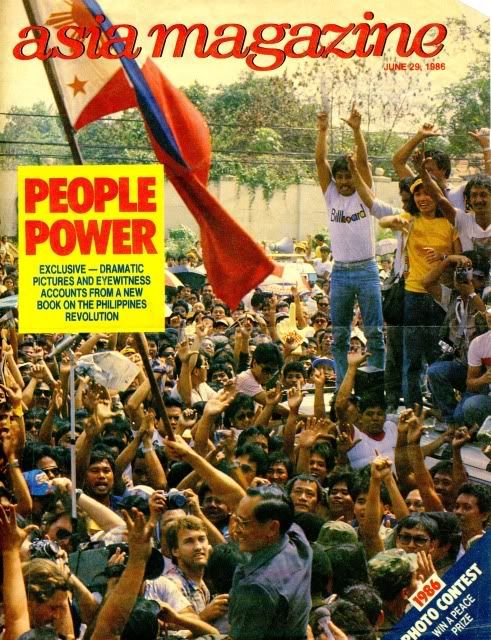
I did keep the front cover of this magazine, not because of any historical significance but because smiling in the crowd was the face of my future.

Cover of Asia Magazine featuring People Power revolution, 1986

But of myself and of my role, I have kept no mementos.

Except ...

The events of 1986 were a coming of age for me and though I forget so many of the details, I only have to reread the stories I have written, revisit the characters I have drawn, to realise that the story of Cory and the 1986 revolution are all there. In my writing.

The girl who yearns for her mother. The boy who realises that what he wants has been there all along. The burden of a wish come true. The blessing that turns out to be a curse. Love, loss, the struggle to understand what is right and what is wrong - the memories I thought I had forgotten are imprinted in my soul — and manifest in my storytelling.

This is what I find when I dig deep, and it all comes from the growing up I had to do in the era of Corazon Aquino.

I also found this:

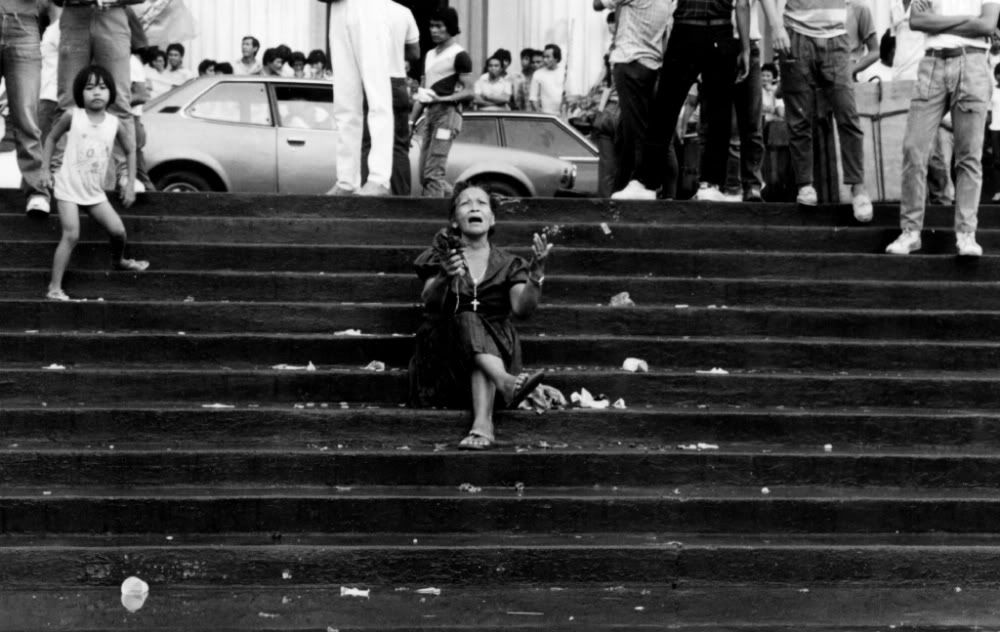
image of mad woman singing Bayan Ko on the steps of the Post Office, 1985. Philippines. Photo by Candy Gourlay.
I took this photo of a woman sitting on the steps of the Post Office in downtown Manila, after one of the frequent anti-government rallies of that time had dispersed.

She was quite mad, holding a plastic rose in one hand and singing in a strong alto Bayan Ko, the song that was to become the rallying anthem of that period.

She was somebody's mother, lost and unnoticed by the crowds.

In 2005, I did a radio programme about the migration phenomenon in the Philippines that has left so many families without a mother. The programme was called Motherless Nation.

I think the photo captures how many of us Filipinos feel now, after the death of Aquino, after all the things that have come to pass these last 22 years.

A nation, motherless.

Tuesday, 4 August 2009

Too much craft ... not enough story?

I was fascinated by blogging literary agent Rachelle Gardner's observation that lately, there have been some rather fine examples of writing craft on her slushpile. Sadly, story doesn't quite live up to technique.
In fact, just this week I read some sample chapters from a newbie writer, and I was impressed with the technical excellence. Nice dialogue, perfect POVs, showing not telling... But the story itself involved a hackneyed plot, a totally uninteresting protagonist, and major predictability. It felt like it was written by a computer program, and it made me sad. I want to teach writers to not only learn the craft, but to also write from their heart. Write with authenticity, write from the depths of personal experience. Read more
Interestingly, this is echoed by author Kathleen Duey (I just read her book Skin Hunger ... oola la, what a fabulous read!) in an interview on the CWIM blog --
Competent novels are harder and harder to sell, in large part because of SCBWI’s wonderful resources, more and more people can write pretty well. But I think too many of us learn the rules—which are far more “teachable”—and lose the spark—which is more “discoverable”. Read more
This past week I attended a residential writing course with authors Malorie Blackman and Melvin Burgess. M&M put us through three or four (THREE OR FOUR!) timed writing exercises everyday - at first giving us five minutes to write but eventually cutting back to just three minutes.
They wanted us to shoot from the hip - no time to think, no time to compose, no time to even contemplate failure. Just write with your guts.
I didn't think I could do it the first time they announced how it was going to be. But I was pleasantly surprised at how it seemed to shock the rust out of my writing gears. Boy, how we wrote! It really helped that Malorie could not resist calling out "one more minute!" just seconds into an exercise.
The exercises all had to do with character, plot, dialogue - approaching each item from every angle you can think of.
I can't share everything I wrote because the thing about not having time to think is you put down stuff that is personal at the very least and at its most dangerous, probably libellous. So rather than get sued by my close friends and relatives here arethree of my least offensive attempts:
Describe navy blue to someone who cannot see ...
You know navy blue, you know it. It sort of swishes underneath everything, dark and wet but warm. It makes other colours look better. Yellow, yellower. Red, redder. It’s not shy but it doesn’t try to step forward either. It’s like an old husband, there, in the background, outside the lamplight, and yet a perfect fit.
Describe rock music to someone who cannot hear ...
It gets behindyour eyeballs, rock music. Like one of those headaches that start at the base of your skull, throbbing behind your eyes. Except that it’s pleasurable. Most of the time anyway. It seizes you by the heart and squeezes, squeezes and it’s like your blood is pumping harder and harder and your brain is going to explode. It’s so hot and yet its so cool.
... And this next one probably set up a few of us for a life-time of therapy, when we were finished, we were all emotionally exhausted from exploring our regrets:
Write up an argument between yourself today and your younger self ...
(In which Now me blames Young me for wasting so much time)

Now me: Why didn’t you start earlier? Why didn’t you do the writing courses, read the books, actually WRITE for goodness sake? Why is it down to me to play catch up, to spend sleepless nights studying and reading and writing – being rejected, suffering the slings and arrows ---

Young me: You don’t remember do you? You don’t remember how hard it was?

Now me: You could have done some writing. There was time. It’s not as if you had to get that A in trigonometry. I can inform you now that I have never had to do cosines and sines and those equations of never letting go ... not once in my lifetime.

Young me: I didn’t have time. Remember M? She needed me ...

Now me: She didn’t. Look at how she’s turned out. She was always going to need you. She was never going to be satisfied all those if only you could do this for me, and if only you could do that for me. She never had any intention of making anything happen. Is she happy now?

Young me: Are you saying it didn’t matter? Looking after the boys, cooking and cleaning and spending al that time at home helping out . None of it mattered? I should have just let all that go and started writing?

Now me: Well, you could have given me a bit of a headstart.

Young me: I did. What are you writing about now? Are you writing about how you started writing earlier? No, all this stuff about belonging ... about loving ... about ... that’s all me. It’s not about YOU. It’s about ME.
Having said that, one of the most memorable lines from this exercise came from my colleague who was just 17 in which her Now Self chided her Young self: "You're just a child!" To which her Young Self replied: "So are you!"

Sunday, 2 August 2009

Arvon's Writing for Teenagers Course with Malorie and Melvin

Painting of Lumb Bank
This painting of Lumb Bank was hanging in my room

Just got back from Ted Hughes' house on Lumb Bank five days with 16 other writers interested in writing for teenagers - 16 rather GOOD writers, I hasten to add. One of my fellow students was 17 years old, still a teenager herself, possibly the next Zadie Smith if she decides this is her thing.

I thought Lumb Bank was in the Yorkshire Dales but it turned out it was just East of Manchester, up the M1 and turn left, through Halifax and up some hilly bits. Miriam drove (thanks Miri!).

Benches, Lumb Bank
We were told to look out for these benches at the top of a little lane
Candy Gourlay. Lumb Bank.
We stopped for pictures before winding our way down the hill.
Ted Hughes Centre. Lumb Bank.
This was the bit of the house looking down a hill at a magnificent view, with disused mills, woods, and a river.
Ted Hughes Centre. Lumb Bank.
I had room number one at the top of the stairs.
Our tutors for the teenage writing week were Melvin Burgess (Junk, Nicholas Dane) and Malorie Blackman (Noughts and Crosses, Double Cross)
Melvin Burgess. Lumb Bank. Malorie Blackman. Lumb Bank.
Malorie and Melvin.
Melvin and Malorie alternated mornings teaching us about plot, character, dialogue with writing exercises that started out at 10 minutes each and by the last day was reduced to three minutes each ... they didn't want to give us the chance to think, to resist, to give up. We submitted samples of our writing to M&M and had one-on-one meetings with each of them in the afternoon to discuss our work and prospects in publishing.
Lumb Bank class.
We sat around a massive table
Lumb Bank.
View outside door as we worked on a rare sunny day.

Malorie made ALL of us read, recalling one tutor's sage words in the early days when she was reluctant to share her work :
Tutor: Malorie do you want to be a writer?

Malorie: More than anything else in the world.

Tutor: Well You’ve got to shit or get off the pot.

The sunshine on the day we arrived turned out to be a red herring. The heavens poured throughout the week. On the few hours when there was no rain, some of us managed to go for walks and visit the nearby village of Heptonstall where Sylvia Plath is buried in a sad, untended plot adorned with tacky souvenirs from her fans.
Lumb Bank.
A rare sunny day.
Heptonstall Village.
The Village of Heptonstall.
Ancient tombstones in Heptonstall's churchyard.
Ancient tombstones laid out in the churchyard.
Sylvia Plath's headstone
Sylvia Plath's headstone. (my camera mysteriously switched to monochrome)

It was a heady week for me. I'd been deep in the mangle of making a living and writing had not been coming easily. Melvin and Malorie opened my rusty tap and allowed the words to flow.
Rainy.
It poured again on the way home.
Welcome home.
Never mind the rain, my homecoming with all the children tumbling all over the bed was fantastic.
My suitcase was several books heavier after the trip. And I take heart from these words of encouragement from Melvin.
For Candy: Nearly there? Keep on writing, Melvin.

Slushpilers go to Arvon!


Share buttons bottom

POPULAR!