Saturday, 13 February 2010

Guest Blogger Gillian Philip: the landscape of us

When I read Crossing the Line, Gillian Philip's evocative teen novel, I was amazed at its unabashed Scottishness. Being from Somewhere Else (sunny Philippines), I struggle with the need to frame stories from within my cultural identity while hoping to appeal to readers in the West where I live. My very first novel (yet to be published - perhaps never), had English characters and a European setting. It had SNOW no less - at a time when I had yet to see the stuff though no longer. I was genuinely afraid anything I wrote would be labelled an 'issue' novel or too foreign to be commercial.
 An agent gently told me in so many words that it would be tough to sell a debut novel by an author who had no cultural connection to the story. So I decided to have a go at a novel with a Filipino element. It was only when I began to build worlds with Filipino characters that I felt my words began to sing . . .

And now here's Gillian!
‘Identity,’ Candy suggested, and I went ‘Gulp.’

I was thrilled to be asked to guest on Candy’s amazing blog, and delighted that she made a suggestion for a subject (because I’m not very good at thinking of them), but as soon as I thought about it my mouth went all dry. I’m not very good at identity either, I realised. But ‘I was very struck by the Scottishness of Crossing the Line,’ Candy told me, ‘which is why I suggested identity.’

Which set me wondering why it did have a strong Scottish flavour. Yes, the book is set in Scotland, though like my other novel Bad Faith, it never says so. Generally speaking, though, readers seem to ‘get’ the setting (Keren David, the author who guested here a couple of weeks ago, got one location right to within about twenty metres). I don’t think I could have set those books anywhere else. I don’t think that’s a strength. It’s probably indicative of a typically Scottish insularity.

I was an expat wife in the West Indies for twelve years and because I was without a work permit for a lot of that time, and childless for all of it, you’d think I would have used my vast quantities of spare time to write. I’d always wanted to be a writer. It wasn’t like my career was going places other than a beach bar at the bottom of our hill.
A gruelling life in the West Indies

Well, I did try, some of the time, at least before sundown. I sold some short stories, and then some more, and I felt pleased with myself though I didn’t enjoy it, because I knew I could never write a whole novel. Nothing occurred to me (see above). I did wring a flimsy sodden half-novel out of my rum-fuelled brain, and while the plot hung together and the story wrapped up rather nicely, it was a load of old tosh, because I believed none of it. The only character I believed in was the rum-sodden beach bar owner (I wonder where that came from) who was, of course, Scottish and homesick.

I suppose no writing is ever wasted and it was all good practice, but I’m happy to say I burned that one. My next project was romantic novels (I was under the all-too-common misconception that these are quite straightforward). I believed these ones, more or less, but Mills & Boon didn’t, so that was that.

Then, in 2001, two babies arrived and I said ‘I’m going home,’ and home we went, and back in the right landscape my brain was hit by an avalanche of stories. It wasn’t just the hills and lochs, I might add, though those came into it; it was the mean streets, the flashy streets and the downright dull streets. It was the weather, it was the light. I was just in the right place, and writing the right stories (between nappy changes). But it wasn’t the people.


Moving to Scotland to take a rest from all that cruel sunshine.

I think it’s a real failing that I couldn’t write a convincing story in a tropical landscape (mind you, I’ve read a few books that think the landscape, some quaint locals and/or oodles of rich people are enough, so not writing was preferable to producing something like that). But in a way, I don’t think I didn’t write about it.

The island where I lived was a small country with a small country’s quirks and disadvantages as well as its charms; so is Scotland. That island’s politics and personalities seeped into my writing; they just became Scottish, and it wasn’t as awkward a transition as I perhaps thought. Virtue and venality, they both travel. I was just writing about people. The way you do.

I think that’s why I haven’t identified Scotland in either Bad Faith or Crossing The Line. It may be my muse (whether I like it or not) but it would be a distraction, to me if to no-one else. That’s not to say I don’t want a strong sense of setting and landscape; I want to write stories that do happen in one place, but could happen anywhere. For Bad Faith I cherrypicked incidents from current affairs all over the world, but set them firmly in an unnamed Scotland. I hope they happen convincingly there, just as I hope that the events in Crossing The Line could happen, with different accents, in another country.
Scotland informs and influences my writing, whether I like it or not. It even kick-starts my writing. I love my birthplace, and at the same time there are things about it that drive me demented with fury and resentment and frustration. I didn’t belong in the West Indies but having lived there for so long, I don’t belong entirely in Scotland any more (now that is a very Scottish phenomenon, just to blow my thesis out of the water). So I would resent being in thrall to the place.

I’ve talked myself into a corner as usual, and I’m not sure what I’d conclude from thinking about this. Perhaps just that I like grounding my stories in a landscape I love; I’m grateful for the way the landscape sparks those stories.

But characters, they travel. They go anywhere and come from anywhere. You can’t confine human beings to one playground. And who’d want to? I have a Scottish identity and it means a lot to me, but I have another identity: I’m a writer. And that means I can really and truly be anyone I want to be.
Gillian Philip blogs on The Awfully Big Blog Adventure. You can find her website here.

Wednesday, 3 February 2010

Guest Blogger Kathryn Evans: fat fibs and proper work

Guest blogger Kathryn Evans is possibly the only belly-dancing-farmer’s-wife- mother-of-two practising to be an author in West Sussex. Nearing the end of her 10,000 year writing apprenticeship, she is currently seeking a home for:
SKIN: Surviving cryostasis for 250 years is the least of Laura’s problems. When her little brother Alfie falls dangerously ill, Laura risks more than her own life to save him. A twisted journey of discovery for 12+.
DYLAN AND MOUSE: Lonely Dylan befriends Mouse, a rodent with a hamster complex and an endless supply of inappropriate costumes. A series of comic adventures for 7+.
All enquires to her agent Sophie Hicks
When Candy asked me to be a guest blogger, I nearly said no. I can’t follow on from  Keren David's guest post! I’ve read Keren's When I was Joe, it’s brilliant.

I am unworthy, unpublished and …ah, in need of publicity. I swiftly changed my mind, before Candy could change hers. After all, this is Notes from The Slush Pile, That I can write about.

I take it seriously, my author apprenticeship. I spend half the week on farm work and the other half writing. By some miracle of parenting, I also find extra bits of week in which I look after my family.


It isn’t easy and makes for conversations like this:
Daughter: ‘Mummy, I need to talk to you about something reeeeaaalllly important.’

Me: ‘Can it wait half an hour darling? I’m working.’

Daughter: ‘You’re on Facebook, aren’t you?’

Me: ‘No. I’m working.’

Daughter: ‘But Mummy, I reeeaaallly need to talk to you.’

Me: ‘Can I just finish this chapter?’

Daughter: ‘Oh, so it’s not proper work then? Good, because I really need a haircut and I don’t know if I should dye my hair red and Mr B*****t was so annoying today and it wasn’t my fault and can I go out on Friday? And, and, and……’
Don’t misunderstand me; I want to listen to my daughter download her day but then, I have to write late into the night. I could just go to bed. No one is going to tell me off. I’m not breaking any contractual obligations.

But I don’t.

I work until my eyes are gritty.

Why?

What is this passion?

Where does it come from?

Maybe it started in 1978, seeing my first poem published. The thrill, the utter thrill of putting words together and seeing them in print; basking in the heart swelling warmth of Miss Heathen’s approval.
Volcano
by Kathryn Hodgkiss
Age 9


I am a volcano, under the sea,
I also live in Italy,
I’m dead now, but my old days were good
As I set off my flames, as fast as I could…
(There were more verses but luckily for you, I can’t remember them.)

Kathy in bellydancing mode: what some folk will do to get noticed

Or was it 1977, when my siblings and I wrote and performed ‘The Water Babies’ for an excited crowd of six. All went well until Lisa, such a Prima Donna even at three, refused to take part unless she had her own hairbrush. Little upstart, we booted her off the show, replacing her with an orange. That orange was as wooden as the bowl it came from, we had to rewrite the whole play.

Spot the Difference.

Or maybe it was 1984, when I started telling big, fat, fibs to make myself sound more interesting? Like the night I had to leave a party embarrassingly early and told everyone I had a modelling job next day. They looked at my 5 foot 2, very ordinary self, with disbelief. I showed them my hands. My dainty fingers were insured for thousands, I bragged, you’ve probably seen them on countless adverts for cuticle cream. I’d never admit Dad had said, be home by half past ten.

In honesty, I don’t know what made me seek this career fraught with poverty and rejection. I do know it isn’t the first time.

For most of my life, I wanted to be an actor (that was definitely to do with ‘Orange Water Baby’).

During my degree in drama, however, I accidentally fell in love with the suntanned neck and broad shoulders of an agriculture student. I couldn’t imagine life without his easy smile so I married him.

 Farming and theatre work are not an ideal mix. And I wanted, wanted, wanted to be with my kids as they grew up and, though I did take them filming on occasion, you can’t build an acting career on the odd bit of work that passes by your doorstep.
I look rough because I was acting, note the hands though, insured for thousands ...

I don’t remember replacing acting ambitions with writing ones, but that is what happened.

Maybe it was having a FRANKLY BRILLIANT, story idea. I typed it up, smiling at my own cleverness. Oh, look at me, I’ve written a book, la la la, stick it in an envelope, la la la, send it off to a few editors la la la wait for the offers to come in.

I got a snowfall of standard rejections.

I wrote another story, only this time, I reread my script and even corrected some of it. Surely, my genius would shine through.

No.

But I did have a rejection from Natascha Biebow. She took the time to critique my work and gave me a brilliant piece of advice. If you’re serious, join SCBWI, learn your craft.

I joined and read and wrote and learnt. The rejections still came but they were more detailed. Beverley Birch even sent me one three pages long. It was the best rejection letter I ever had.

I ‘finished’ SKIN and sent it to an agent. An email came back.

‘I like this,’ said Sophie Hicks, ‘let’s talk.’

SOPHIE HICKS!

Kate Thompson’s Agent. *Swoon*. Eoin Colfer’s Agent. * Double swoon* My heart leapt out of my chest and did a little dance all by itself. This was it, I’d made it!

Gratuitous photo of bestselling children's writer Eoin Colfer with whom I share an agent

Not quite.

Making it to print (and staying there) will always hinge on the next person loving what I do - be that agent, publisher, bookseller or reader.

So bring on the late nights because I do have obligations. If I want to be read, I have to be good. It’s a competitive business and I owe it to Sophie, and everyone else who reads me, to be the best I can be. And one day, one day, maybe I’ll say to my daughter:
"It is proper work."
And I won’t be telling a big, fat, fib.

Friday, 29 January 2010

Thoughts on Surviving This Digital Revolution

On the launch of the iPad, some thoughts on how tools are driving content and an interview with Melvin Burgess about his Twitter Tales


If you can't see this video, watch it on YouTube.Thanks Jeannette Towey for posting this on FB

"Over 10 years we have lived through a revolution." Ed King head of the British Library's newspaper archive
When Ed King said this, he was referring to the digitisation of his archives. But it's so true in everything that we do - from reading a book to booking a plane ticket. Our lives have been transformed by technology.


With the launch of the iPad, the blogosphere is buzzing with people who want to declare how much they love it or hate it.

The iPad is yet another step into a Tomorrow that we are only just beginning to imagine.

It fascinates me that a gadget like the iPad is predicted to transform the world of story and reading.

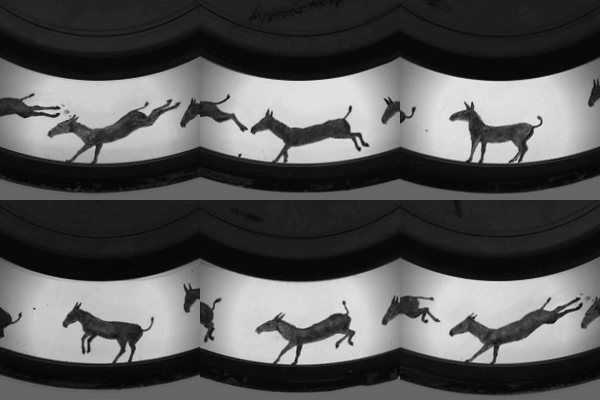
Through the ages, tools have dictated the development of content: the printing press led to books, the zoopraxiscope led to movies, the camera to photography, and so on.


From Wikipedia under Creative Commons License

But it's important to remember that the tool is nothing without the content it provides. And as authors, who are the creators of content, it is our role to shape the future that these tools are set to deliver.

Some are already experimenting with the new media available - the Japanese download text novels on their mobile phones, today I heard about augmented reality picture books, and authors like Kathleen Duey are experimenting with twitter novels and short stories (an aside: this is not new media, but has anyone listened to the BBC's Out Loud archive of poets performing their own work? Brilliant!) ...

Deep Love, the first ever cell phone novel

I've been following the Twitter short stories that author Melvin Burgess (my review of his book Nicholas Dane here) has been posting.

Melvin Burgess. Photo by John Coombes

They are odd, poetic and strangely affecting. Melvin says they are "not to everyone's taste" but there's something compelling about them.
I was just mucking around – trying out Twitter and wondering what tweets were. Of course, all a tweet is, is a not-too-long sentence – but I was thinking of them of having some particular quality to them. Then one day I came up with the sentence – You're pushing a pram down the road. An old lady looks inside and says fearfully, "Your babies are not human."

It reminded me of something I used to do years ago, while I was learning how to write – I’d sit down in the morning and just launch off with a sentence – anything, like they used to make us do in school – and just see how it went. So I thought I’d try the same thing here. That was the first twitter story, The Dancer. I’ve kept it up because the results are surprising and interesting – and because after writing novels for so many years, it’s a real reliefe to do something that can just take me wherever it wants to go. It’s fun.
I think the Twitter Tales are exciting (and surprising is a really good word for it)... but since I don't like to stay connected to Twitter all the time, I have to go back to his website to catch up. Says Melvin:
Twitter is bad place to post stories because they go up backwards and people find it difficult to keep up with them. I think a lot of people, like you, went to the website to catch up, so lately I’ve been trying posting links on my website. It makes them easier to read, but I don’t think it gets so many people’s attention.
Indeed it's very tempting to explore these new forms. When I first heard about Japanese text novels I was sorely tempted to try and write one. It's funny how the limitations of a form seems to promise endless possibility! It would be, as Melvin says, Good Fun (if, that is, you like to write).
Various people do story telling on twitter – many try to make a story out of a single tweet, which is another thing altogether. I’m not aware of anyone doing exactly the same thing though. And yes, it certainly is satisfying – I love it. I’d really recommend it to anyone who likes to write – it’s a really liberating way to work. So far, most of them have turned out kind of OK, but I’d be quite happy to ditch one if it turned out duff. No pressure – good fun. And the fact that you do it one sentence at a time makes it easy to write, somehow.
There is a poetic quality to the stories ... like a novel in Haiku form. Says Melvin:
I do like the final product, although I think they still need a bit more work. One day I’ll go through the best of them and polish them up, As for story I  like this as a form – well, maybe it’ll turn out to be something, I’m not sure. It is, as you say, poetic – a kind of free form narrative poetry, in a way. Whether or not it’ll catch on is another matter, but one, day, I’m sure I’ll use them for something. Maybe I’ll get them set up as Apps for iPhone or something like that …
Funny, that. I've been researching how to produce freebies for punters to download on my site ... all those picture books I've written that nobody seems to want to publish - I want to produce little e-books to give away to be read on mobile phones and Gameboys. But it's a bit beyond my technical ability (for now).

I asked Melvin what his Twitter short stories are telling us about technology and its impact on culture.
It isn’t just Twitter – everyone is running around trying to find out how they can use new media to tell stories. It’s an exciting area because no one knows how it will turn out. I did a TV and online project for BBC Switch a while ago called The Well, that had a big online element – a game in which new areas of drama were hidden. That was interesting too. The programme maker, Conker Media, is very much at the forefront of using new media for broadcast and online and I hope to do more with them. It’s something every writer should keep an eye on.
Still from The Well

Screenshot from The Well game

It's a brave new world out there for authors. What's next?
Who knows? I hav a couple of online projects I’m having meetings to develop next month. There’s possibility as well that we might try to film one or two of the twitter tales. Interesting times we live in!
Interesting times indeed.

Share buttons bottom

POPULAR!