Saturday, 15 August 2009

Learning from Toy Story 2's Audio Commentary

Buzz and Woody in Toy Story2
I am thinking of turning a fantasy novel that I have written into a trilogy.

And whenever I’m in need of something to freshen up my writing, I turn to the audio commentaries of my favourite movies. It’s like reading a familiar book with the voice of the author in your head discussing how he worked it all out.

One of the best I've heard is the audio commentary for Toy Story 2 - featuring director John Lasseter, co-directors Lee Unkrich and Ash Brannon, and writer Andrew Stanton.


Listening to the Toy Story 2 team discuss how they plotted and schemed, how they played the audience, planting all the set ups, how they tightened the screws and tightened the scenes, the scenes that were shed pretty much evokes what it's like to write a novel.

The fact that Toy Story 2 is a sequel throws up interesting dillemas which might fascinate folks working on their own sequels or trilogies or series.

Like, how do you surprise an audience that knows your characters so well?

How do you remind the reader or audience (in the most economical way) what the key characters care about?

How does a character go forward when he has already completed his arc in the previous episode?

How do you bring back characters from the previous episode without boring exposition, how do you (again, economically) bring these characters in actions and scenes instead of endless boring paragraphs?

Andew Stanton described making a sequel as ‘overwhelming’ because of the seemingly ‘insurmountable goals’ – not least of which was the high expectation that came from having had a successful first episode.

The team had to find ways to reprise what was wonderful in the first story without compromising story in the sequel. For example, how does one bring back the fun of the first Toy Story's Buzz Lightyear, who thought he was a real spaceman and not a toy?

"Half the reason it was so much fun to watch Buzz was that he was deluded," Stanton says. In Toy Story 2, Buzz meets another Buzz Lightyear in a toy store, who is even more deluded than he was in the first Toy Story. The fun begins when the other Buzz swaps places with him and Buzz's friends don't realise they are not with the real Buzz

How do you make an idea fresher, faster, better, more surprising, more exciting, more unexpected?

The humour, the staging, the action and the great visuals ... we knew they would come. But it was that emotion that was so important because what we value is a story in which characters change, in which characters grow. In Toy Story we were very proud of the way Woody and Buzz both grew. And we couldn’t make them go back and get amnesia and grow in the same way again. They had to grow in a different way and that was extremely challenging.

Once a book/film is out, the author/filmmaker gives up ownership of his or her characters. Suddenly, the stakes are higher, because, as John Lassiter says, "These characters don’t belong to us anymore they belong to the world ... We had to do it right. We had to do it great."

It does make you think.

These characters we have been living with and whose lives we’ve been creating all this time? Ultimately, they are not ours to keep.

Tuesday, 11 August 2009

Titian: the Last Days by Mark Hudson -- a book trailer made by his daughter (hee hee)

Should we get our kids to help promote our books?


Love the part where she says: "I think it's boring but my mum read it and she thought it was really ... interesting."

Late add: This video is testament to the hoops authors have to jump through to sell their books. I just read Nathan Bransford's recent blog post in which he asks:
Can you be "just an author" these days, pecking away at a typewriter in a basement somewhere but otherwise completely eschewing publicity and remaining out of the public eye, Salinger- and Pynchon-style, writing in a bubble-like Platonic ideal of authordom?
His conclusion is that an established author could probably pull off a hermit-profile. But really, what with the economy in dire straits, publishers want bang for their buck ...
And one of the best ways to get bang for the buck is to start with an author who is doing everything they can to help out with publicity, thus multiplying the publisher's efforts
We have to live with the realities of our time and sometimes that means making the most of YouTube.

Saturday, 8 August 2009

Digging Deep and Finding Your Heart Elsewhere

corazon aquino as Time Magazine's Woman of the YearI often write about digging deep — about scrounging around deep down to find you know, that essence of who you are, the thing that will make your writing really ring true, really sing.

Well, this week I dug deep and found that my heart was elsewhere.

In my native Philippines, it's been a traumatic week.

Corazon Aquino, the former president, died and there has been a great outpouring of grief and a mass recollection of the tumultuous revolution that catapulted this housewife (who looked remarkably like my mother) to power. She was a woman forced into a role she did not choose, inheritor of the shambles left by a 20 year dictatorship, a president of many imperfections. Her enforced leadership was no gift to this shy, unassuming woman.

My beloved former editor, Letty Jimenez Magsanoc, sent out a message to all us former staff writers now scattered across the world to send in our recollections of Aquino.

Living here in London as I do, I found it difficult to summon memories of that period. Was it the passage of time? Or had my brain grown fat in this country where freedoms are taken for granted, hunger is a concept, and people speak in complete sentences? It's all very well to talk about digging deep to my fellow writers. I had not kept a diary. What if I dug deep and found nothing?

My journalist friend Elizabeth recently wrote a piece for Granta on the conflict between memory and reality in her experience of the Tiananmen Square massacre
We take fragments of memory and weave them together into patterns as best we can. We darn or embroider any holes with threads of things that happened in our readings, in our conversations with others who really were there, in our dreams.Those then become part of the fabric of our storytelling, so that soon enough it is impossible to say what was remembered and what was embroidered. Read her essay here
I searched my photo albums and mementoes of the days leading up to and after the revolution of 1986. One thing is for sure, I took no photos. I had no film. I experienced history with an empty camera. And none of my photographer friends could risk their supplies and spare me a roll.

In the many photos, of the crowds, the journalists chasing the personalities of the day, I know where I am. I was standing on the other side of that tank as the nuns cowered under its tracks. I was on a balcony watching the helicopters descend on the military camp. I was sitting on the bridge as the people stormed the palace. But no, I cannot find myself in any of the pictures. It's as if I was never there.

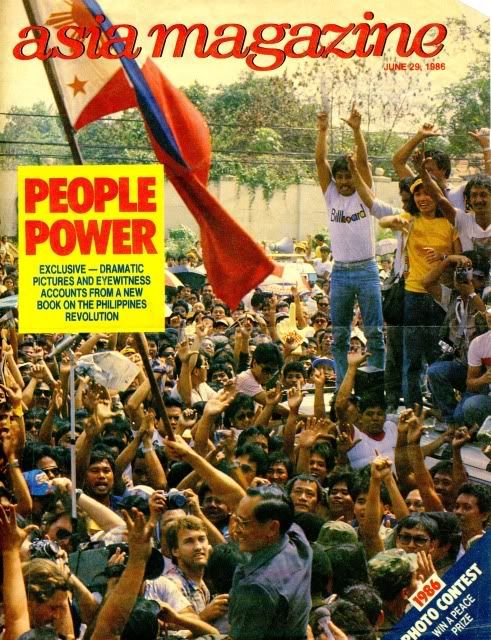
I did keep the front cover of this magazine, not because of any historical significance but because smiling in the crowd was the face of my future.

Cover of Asia Magazine featuring People Power revolution, 1986

But of myself and of my role, I have kept no mementos.

Except ...

The events of 1986 were a coming of age for me and though I forget so many of the details, I only have to reread the stories I have written, revisit the characters I have drawn, to realise that the story of Cory and the 1986 revolution are all there. In my writing.

The girl who yearns for her mother. The boy who realises that what he wants has been there all along. The burden of a wish come true. The blessing that turns out to be a curse. Love, loss, the struggle to understand what is right and what is wrong - the memories I thought I had forgotten are imprinted in my soul — and manifest in my storytelling.

This is what I find when I dig deep, and it all comes from the growing up I had to do in the era of Corazon Aquino.

I also found this:

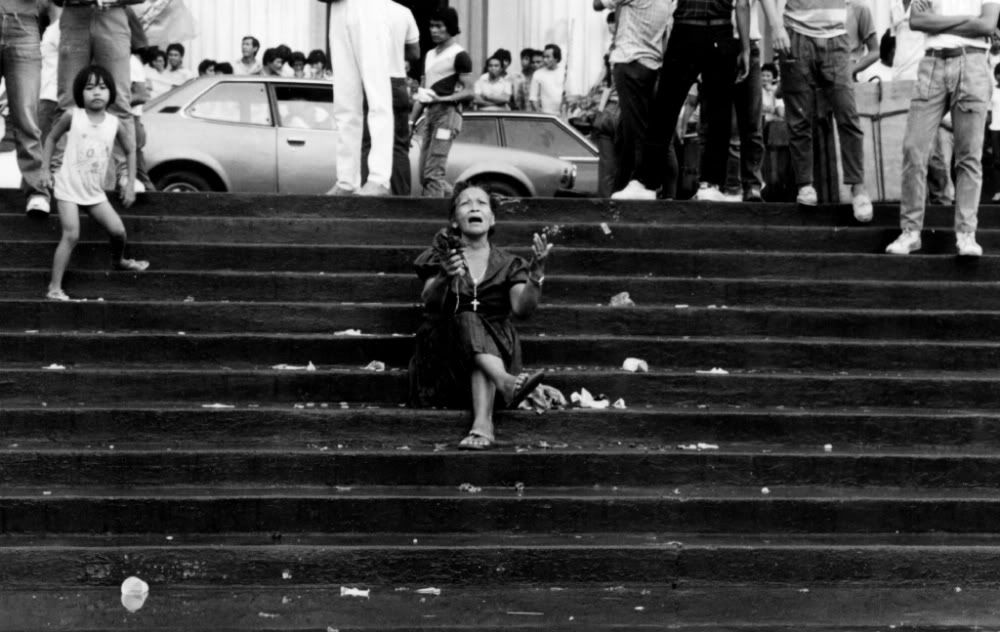
image of mad woman singing Bayan Ko on the steps of the Post Office, 1985. Philippines. Photo by Candy Gourlay.
I took this photo of a woman sitting on the steps of the Post Office in downtown Manila, after one of the frequent anti-government rallies of that time had dispersed.

She was quite mad, holding a plastic rose in one hand and singing in a strong alto Bayan Ko, the song that was to become the rallying anthem of that period.

She was somebody's mother, lost and unnoticed by the crowds.

In 2005, I did a radio programme about the migration phenomenon in the Philippines that has left so many families without a mother. The programme was called Motherless Nation.

I think the photo captures how many of us Filipinos feel now, after the death of Aquino, after all the things that have come to pass these last 22 years.

A nation, motherless.

Share buttons bottom

POPULAR!